 Log In
Search




 Open Access
 liyuanzhao035@foxmail.com
youngstar_sf@163.com
liyuanzhao035@foxmail.com
youngstar_sf@163.comShufang Cui, Department of Laboratory Animal Sciences, School of Basic Medicine, Naval Medical University, 800 Xiangyin Road, Yangpu District, Shanghai 200433, China. E-mail: youngstar_sf@163.com. Liyuan Zhao, National Key Laboratory of Immunity & Inflammation, Naval Medical University, 800 Xiangyin Road, Yangpu District, Shanghai 200433, China. E-mail: liyuanzhao035@foxmail.com.
Received October 29, 2025; Accepted November 25, 2025; Published April 1, 2026
Proposes a “trinity” reform framework: a framework that centered on animal welfare ethics, supported by virtual simulation technology, and driven by innovations in management and assessment systems.
Enhances teaching reform and professional development: to improve the effectiveness of teaching and to cultivate future professionals in life sciences who are innovative, practical, and ethically responsible.
Provides a comprehensive solution for curriculum reform: to provide a forward-looking, implementable solution for comprehensive curriculum reform of laboratory animal science in higher education institutions.
Open Accessliyuanzhao035@foxmail.comyoungstar_sf@163.comShufang Cui, Department of Laboratory Animal Sciences, School of Basic Medicine, Naval Medical University, 800 Xiangyin Road, Yangpu District, Shanghai 200433, China. E-mail: youngstar_sf@163.com. Liyuan Zhao, National Key Laboratory of Immunity & Inflammation, Naval Medical University, 800 Xiangyin Road, Yangpu District, Shanghai 200433, China. E-mail: liyuanzhao035@foxmail.com.
Received October 29, 2025; Accepted November 25, 2025; Published April 1, 2026
Proposes a “trinity” reform framework: a framework that centered on animal welfare ethics, supported by virtual simulation technology, and driven by innovations in management and assessment systems.
Enhances teaching reform and professional development: to improve the effectiveness of teaching and to cultivate future professionals in life sciences who are innovative, practical, and ethically responsible.
Provides a comprehensive solution for curriculum reform: to provide a forward-looking, implementable solution for comprehensive curriculum reform of laboratory animal science in higher education institutions.
Keywords: Laboratory animal science, Teaching reform, Virtual simulation, Animal welfare ethics, 3R principles, Curriculum-based ideological and political education, Blended learning
1.1 Academic significance and contemporary challenges: the core role of laboratory animal science in life sciences
Laboratory animal science is a highly interdisciplinary and practice-oriented science. It occupies an irreplaceable core position in modern life sciences, basic medicine, and drug research and development (R&D) [1]. It makes a fundamental contribution to scientific discoveries. For example, in neuroscience, scientists discovered a vital protein, FTL1, via animal experiments; overexpression of FTL1 in the mouse brain led to memory loss and weakened neural connections, while lowering its expression restored memory function in aged mice. This finding suggests that FTL1 may function as a “master switch” controlling the aging of the brain [2]. Similarly, in the field of regenerative medicine, a research team successfully combined 3D-printed neural scaffolds with lab-cultured spinal cord organoids in a rat model, significantly enhancing motor function recovery, bringing new hope to spinal cord injury repair [3].
Such innovative achievements are largely due to solid understanding of and practical expertise in laboratory animal science. However, it also points out a critical challenge, that is, the increasing complexity of technical requirements and ethical norms in modern scientific research is outpacing the traditional teaching models still prevalent in most universities. If educational methods don’t adapt to these innovations, graduates may struggle to get involved in frontline research, therefore hindering national progress in these scientific fields [4].
1.2 Limitations of the traditional teaching model: the impetus for reform
While laboratory animal science is becoming increasingly important, its traditional teaching methods faces significant challenges. Many courses are still dependent on “verification” and “demonstration” experiments, lacking a focus on innovative experimental design training. Traditional pedagogic means, such as rote memorization or passive “stuffing” of knowledge, lacks interaction between teachers and students, resulting in lower student involvement [5]. Additionally, variations in teachers’ academic background and the absence of standardized teaching guidelines contribute to inconsistent teaching quality, including differences in operational details and focus areas. Moreover, teaching resources remain scarce and expensive. Live animal experiments incur great expenses and safety issues [6]. More importantly, operational errors may cause irreversible consequences, such as death of animals or inactivation of tissues. High risk, high cost, and low repetitiveness of these practices make large-scale, individualized practical education difficult to implement, conflicting with the growing emphasis on animal welfare ethics in modern society [7].
1.3 Research background and objectives: establishing a comprehensive teaching framework for the new era
Facing such challenges, a systematic reform of laboratory animal science courses is imperative. This study proposes a teaching reform model grounded in ethics, supported by technology, and secured by management. This framework aims to integrate cutting-edge research findings, best practices, exemplary values, and advanced computational concepts into teaching practices. It fosters an educational philosophy that equips students to engage in reality while guiding them to appreciate the value of honest and intelligent learning. This strategy aligns with China’s higher education requirement for “curriculum-based ideological and political education” and adheres to internationally recognized standards for laboratory animal welfare. It is dedicated to cultivate high-level specialists capable of meeting the evolving requirements of life sciences field.
2.1 Disconnection between curriculum and frontier research
The current courses lag behind disciplinary advancements and are heavily relied on verification-based experiments [1, 5]. With the emergence of highly innovative interdisciplinary research areas, such as 3D printing for spinal cord repair and exploring critical proteins for brain aging, textbook-driven teaching methods struggle to cultivate students’ ability to independently design and solve difficult scientific problems [2]. If traditional curricula fail to evolve, students may lack the ability to conduct innovative experimental designs and implement the experiment after entering graduate school or the workforce [8].
2.2 Misalignment between teaching mode and student needs
Traditional “cramming” teaching mode places teachers at the central position of the classroom while students remain passive recipients. This hinders learning motivation and proactive engagement, with many students viewing course attainment merely as a means to get “credits” and some teachers regarding teaching as a task to be completed. Evaluation of teaching effectiveness is overly stringent, relying primarily on final exam score and neglecting comprehensive evaluation of student’s experimental skills and innovative thinking [9, 10]. Moreover, differences in teachers’ professional backgrounds lead to variations in instructional emphasis and operational approaches, making it difficult to standardize teaching quality and implement uniform training programs [11, 12]. However, the use of modern information technology, such as smart classrooms, has significantly enhanced teacher-student interaction and student engagement, providing strong empirical support for reforming traditional teaching models.
2.3 Scarcity of teaching resources and safety risks
Traditional animal-based teaching heavily relies on physical resources, including live animals, expensive equipment, and specialized laboratory facilities. This leads to high teaching costs, limits the repeatability of experiments, and restricts access to hands-on opportunities [13]. Furthermore, animal experiments inherently carry safety risks: complex surgical or dissection procedures require special protective measures [14].
Table 1 compares traditional and innovative teaching models in experimental animal science, clearly demonstrating the necessity and feasibility of reform.


By analyzing the challenges confronting traditional laboratory animal science teaching in China, this study proposes a new “trinity” teaching framework centered on animal welfare, supported by virtual simulation technology, and linked by an innovative evaluation system.
Unlike earlier reforms that merely addressed isolated components, the trinity framework integrates three parallel tracks into a mutually reinforcing engine. Traditional models treat ethics, technology, and assessment as add-ons: welfare as a side lecture, simulation as an optional lab, and evaluation as a final numeric stamp. We knit them into a unified braid: animal welfare ethics establish the non-negotiable target, virtual simulation supplies a risk-free space for ethical decision-making practice, and the revamped assessment system converts every welfare-centered action into credit-bearing evidence. These parts are not stacked but interlocked: remove one, and the other two collapse. This ensures moral concerns drive software design, while the software instantly feeds back into scoring logic. This interlocking mechanism makes the trinity framework a new species of reform, not an incremental upgrade.
3.1 Legal and ethical framework: from regulation to practice
In the new era, laboratory animal science education must prioritize ethical education. In recent years, China has established an increasingly comprehensive system for laboratory animal management and ethical review. For example, the Sichuan Provincial Regulations on Laboratory Animal Management (issued in 2025) explicitly stipulate that the use of laboratory animals must adhere to the 3R principles (Replacement, Reduction, Refinement). It further requires institutions engaged in laboratory animal work to establish welfare and ethics review bodies for assessing risks and reviewing scientific activities [15, 16].
3.2 Educational application of the 3R principles: replacement, reduction, refinement
As the foundation of laboratory animal welfare ethics, the application of the 3R principle in educational settings can be viewed as a specific pathway for transformation [17]. Table 2 provides specific strategies and examples for implementing the 3R principles in educational settings.

Replacement: replace lower-order animals or non-animal models with higher-order animals (more sensitive to pain) without sacrificing experimental objectives. Virtual simulation technology serves as an effective tool to achieve this principle [18]. Students use virtual platforms to perform dissection, surgeries, and physiological experiments without using live animals. This approach avoids ethical concerns associated with live animal experiment while overcoming teaching challenges such as animal resource shortage and operational safety risks.
Reduction: Minimize the number of experimental animals while ensuring the reliability of results. Virtual simulations enable students to repeatedly practice procedures before hands-on work, so they can mater operational procedures and technical skills. This can reduce experimental failure rates due to operational errors and minimize unnecessary animal sacrifice.
Refinement: optimize experimental design in studies requiring animal use to minimize animal suffering and stress. Animals are provided with comfortable living conditions, and students are trained in standardized anesthesia protocols and pain management practices. Additionally, students receive instruction in proper handling and restraint techniques to avoid stress or injury. Integrating these principles into fundamental curricula enhances both ethical awareness and professional competencies among students.
The 3R principles should serve as an intrinsic driver of curriculum design, rather than constrains imposed by moral needs and technological limitations. Directly adopting “alternative” experimental animals promotes the application of virtual simulation technology in education; such technological innovations offers multiple advantages in teaching efficiency, safety, and cost control.
3.3 Curriculum-based ideological education and life-centered awareness
In China’s higher education system, the promotion of “curriculum-based ideological and political education” creates a good opportunity to reform the teaching of laboratory animal science [19]. By integrating explicit ethical principles—such as respect for life and compassion for animals—with professional knowledge, students can cultivate integrity and patriotic sentiment. Incorporating stories behind life science research enhances course appeal, prompting attention to the necessity of balancing scientific progress with ethical responsibility while guiding students to cultivate rigorous scientific attitudes and integrity. This model combines moral education and technical training, enabling students to recognize that learning advanced technologies is closely related to a profound life-centered consciousness. This is an important quality for cultivating life science professionals [20].
4.1 Comprehensive advantages of virtual simulation technology
Virtual simulation technology is a significant innovation in laboratory animal science education, offering four key advantages [21]. This technology realistically replicates practical operational scenarios, making contexts tangible and immersive. It enables students to engage deeply and persistently in experimental processes, significantly stimulating learning interest. Virtual platforms unify teaching practices to achieve standardized instruction, resolving the issue of quality inconsistencies caused by different teachers. Virtual experiments also reduce costs of experiments by minimizing the need for expensive live animals and materials. Operations within virtual environment can be repeated without error, allowing students to safely practice repeatedly until skill mastery. This minimizes errors in live animal experiments, fundamentally protecting animal welfare and mitigating potential risks.
4.2 Developing a blended virtual-physical teaching model
To maximize the value of virtual simulation resources, it is suggested to establish a blended teaching system where “virtual experiments complement physical experiments” and “virtual training integrates with physical practice”.
This approach should be implemented simultaneously before, during, and after class. Through MOOC (Massive Open Online Courses) and virtual simulation platforms, students independently learn theoretical knowledge before class and master key experimental skills through Pre-assignments and simulation practices. For instance, virtual modules can guide students through the complete workflow of animal functional gene expression experiments, including knowledge learning such as nucleic acid extraction, PCR technology, DNA digestion/ligation. Pre-class virtual training significantly enhances the efficiency of hand-on experiments, allowing teachers to focus on guiding students in applying theoretical knowledge and fostering innovative thinking. Smart classrooms can further enhance classroom interaction. Post-class field trips to experimental animal center or animal breeding facilities enable students to directly observe animal behaviors and welfare measures, deepening their theoretical understanding while cultivating their respect for life.
4.3 Analysis of typical virtual simulation teaching cases
Several successful virtual simulation teaching examples have provided practical references for this reform. The College of Veterinary Medicine at Yangzhou University developed a three-dimensional digital anatomy virtual simulation platform for animals such as dogs [22]. This platform enables students to gain a more intuitive and in-depth understanding of animal anatomical structures, overcoming the limitations of traditional anatomical teaching and providing practical opportunities free from ethical constraints. Northwest A&F University introduced a virtual simulation module for molecular biology experiments, covering eight virtual projects including nucleic acid extraction, PCR, and cell transfection [23]. This allows students to learn complex procedures and precautions for molecular experiments online, thereby enabling efficient offline practice.
These cases prove that virtual simulation technology comprehensively enhances teaching efficiency, enriching instructional content, and integrating ethical education.
5.1 From single-dimension to multi-dimensional: building a process-oriented comprehensive assessment system
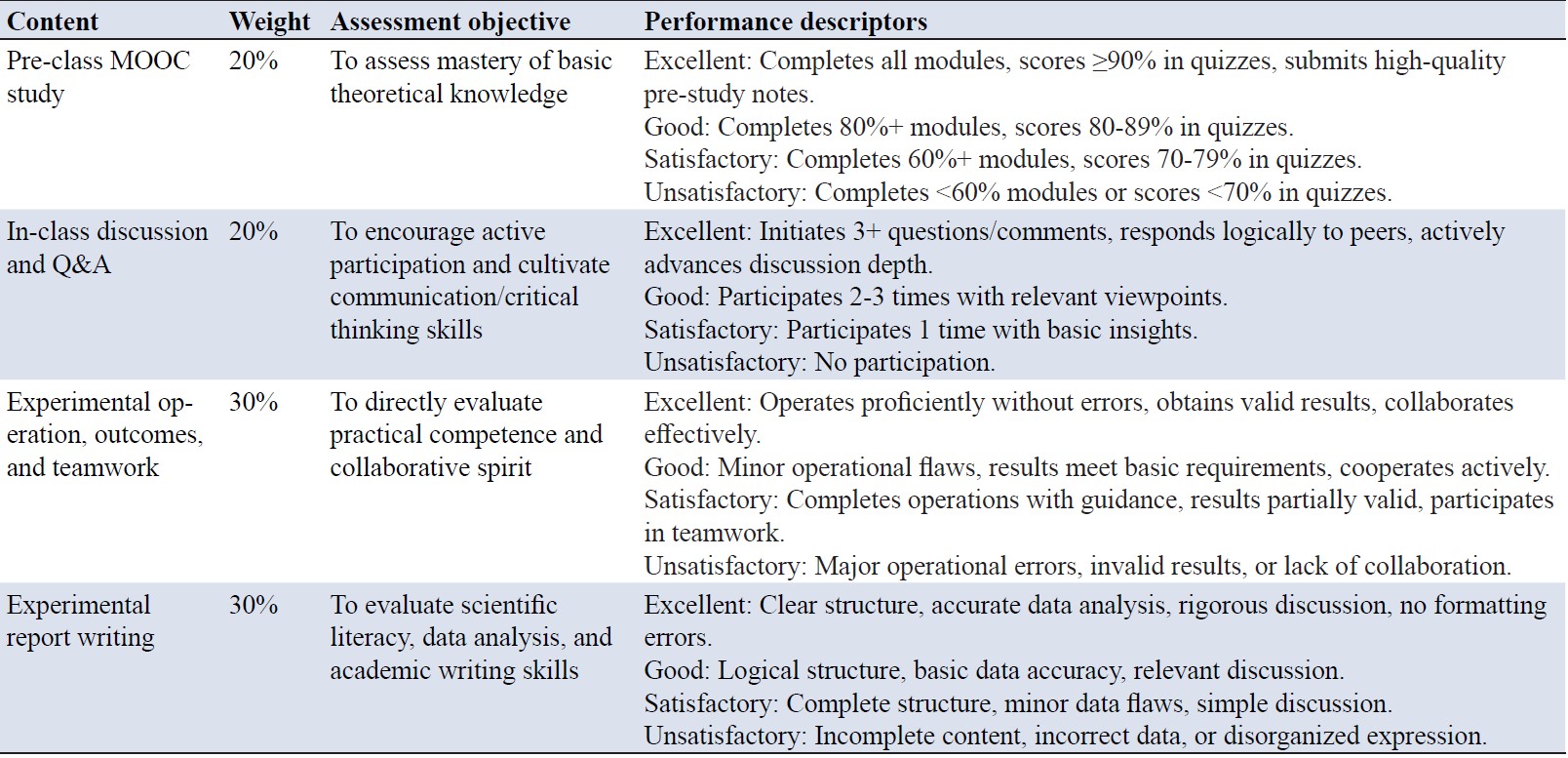
To stimulate student engagement in the classroom and foster holistic development, transforming assessment techniques is crucial—traditional systems are overly rigid and fail to provide appropriate evaluations. Therefore, the entire assessment process must focus on the process itself. Based on the above theories, the scoring model is illustrated in Table 3. Diverse process-oriented assessments closely correlate with the final results of students’ learning, focusing on continuous efforts and holistic skill development to better cultivate comprehensive competencies required for real-world scientific research.
5.2 Strengthening teaching faculty development
Teacher self-improvement is the foundation of educational innovation. The faculty should maintain stability, possessing both teaching and research capabilities. The team should comprise multidisciplinary talents, with instructors responsible for curriculum development, instructional design, teacher training, and comprehensive quality control. Moreover, faculty members must continuously update their knowledge systems. To keep students in touch with the latest advances in science and industry, teachers need to constantly refresh teaching content and incorporate the latest research and practical achievements. Continuous professional development helps teachers maintain optimal teaching performance, thereby providing students with valuable academic advice [24].
6.1 Overview of comprehensive reform pathways
The proposed curriculum reform for experimental animal science presented in this article constitutes a holistic solution grounded in ethical guidance, driven by technological innovation, and supported by management systems. Core initiatives include: deeply integrating animal welfare ethics to cultivate students’ awareness of life; fully leveraging virtual simulation technology to overcome limitations existing in traditional teaching, such as high costs, significant risks, and low repeatability, thereby achieving efficient, safe, and standardized practical education. Innovating management and assessment system to shift from one-sided knowledge assessment to comprehensive competency evaluation. This multidimensional reform addresses shortcomings in traditional teaching while actively responding to the constantly evolving demands of modern scientific research and talents cultivation.
6.2 Future directions and challenges for laboratory animal science education
There remains significant room for reform. With the development of artificial intelligence (AI) and big data, future virtual simulation platforms will integrate AI tutoring systems to provide students with real-time personalized evaluation of their operations. Simulation of dynamic complex life systems will provide more customized learning experience [25]. At the same time, legislative and ethical frameworks will evolve, requiring teaching content to be continuously updated with the development of technology. Major future challenges include: maintaining virtual simulation resources that incorporate the latest scientific progress; and expanding this novel teaching model to more universities to benefit a broader student population.
This study provides ways and methods for reforming experimental animal science education in the new era. Rapid advancements in cutting-edge life sciences have exposed the limitations of traditional teaching models. Through in-depth analysis of current issues, this paper constructs a novel “trinity” reform framework: centered on animal welfare ethics, supported by virtual simulation technology, and establishing a new management and evaluation system. This research provides a forward-looking and implementable comprehensive solution for the systematic reform of laboratory animal science curricula in higher education. By adopting this reform framework, educational institutions will be better prepared to help students enter the modern life sciences field, equipping them with the knowledge and skills needed to be influential contributors while adhering to the highest standards of animal welfare and ethical norms.
Author contributions
Min Zhang wrote the manuscript, Yijie Tao and Sheng Xu investigated the current teaching methods of “Laboratory Animal Science” in China, Liyuan Zhao revised this manuscript, Shufang Cui formulated the research direction and confirmed final manuscript. All authors reviewed the manuscript. All authors contributed to the article and approved the submitted version.
Funding
This work was supported by the 2025 Annual Teaching Achievement Cultivation and Development Project of Naval Medical University (JPY2025B29).
Data availability
Not applicable.
Ethics approval and consent to participate
Not applicable.
Consent for publication
Not applicable.
Competing interests
The authors declare that they have no competing interests.
Acknowledgements
Not applicable.
[1] Xu D, Mai Z, Gao W, Mei X. Exploring the teaching reform in laboratory animal science through the "teaching-learning-application" model. J Bio. 2025;42(5):126-130. https://doi.org/10.3969/j.issn.2095-1736.2025.05.126
[2] Remesal L, Sucharov-Costa J, Wu Y, Pratt KJB, Bieri G, Philp A, et al. Targeting iron-associated protein Ftl1 in the brain of old mice improves age-related cognitive impairment. Nat Aging. 2025 Oct 1;5(10):1957-1969. https://doi.org/10.1038/s43587-025-00940-z
[3] Han G, Lavoie NS, Patil N, Korenfeld OG, Kim H, Esguerra M, et al. 3D-printed scaffolds promote enhanced spinal organoid formation for use in spinal cord injury. Adv Healthc Mater. 2025;14(24):e04817. https://doi.org/10.1002/adhm.202404817
[4] Zhou L, Chi W, Lin Y. Exploration and practice of ideological and political education in the practical course of zoology in local universities. J High Educ. 2024;10(33):185-188. https://doi.org/10.19980/j.CN23-1593/G4.2024.33.045
[5] Kang Y, Li J, Ding P, Xu C, Zhang M, Tian J. Analysis of research hotspots and trends in "medical experimental zoology" teaching. Med Educ Res Prac. 2024;32:415-422.
[6] Zhao Y, Xu Q, Huang W, Niu H, He J. Discussion on the risk management of biosafety of experimental animals in universities. Exp Tech Manag. 2024;41(10):242-249. https://doi.org/10.16791/j.cnki.sjg.2024.10.032
[7] Jiao H, Pang J, Pan J, Zhang X, Zhang X, Wang A. Investigation on the current situation of ethical education on experimental animals for medical students. J Chengde Med Univ. 2021;38(04):354-357. https://doi.org/10.15921/j.cnki.cyxb.2021.04.026
[8] Pi J, Liang Y, Zeng D, Zhao D, Yang F. Exploration and practice of promoting the concept of "three pronged education" through "scientific research education" in the cultivation of undergraduate talents in medical technology. J Sci Educ. 2025;(22):106-110. https://doi.org/10.16871/j.cnki.kjwh.2025.22.023
[9] Guo H, Wen C. "Emphasizing scientific research over teaching" in medical schools: Phenomenon, causes, impact, and solutions. Basic Med Educ. 2025;27(10):938-942. https://doi.org/10.13754/j.issn2095-1450.2025.10.07
[10] Gao B. Practice of formative evaluation of medical ethics education in local colleges and universities of TCM. Value Eng. 2017;36(29):252-253. https://doi.org/10.14018/j.cnki.cn13-1085/n.2017.29.104
[11] Wang J, Yue S, Yao Q. Analysis of the status and needs for teaching ability training of traditional Chinese medicine nursing clinical teachers under the background of collaborative nursing and education. Health Voc Educ. 2025;43(02):123-126. https://doi.org/10.20037/j.issn.1671-1246.2025.02.34
[12] Ning Z, Liu J, Zhai X, Yang G. Research on strategies for enhancing the teaching innovation ability of young teachers in medical higher education institutions. J Pract Med Tech. 2025;32(04):311-314. https://doi.org/10.19522/j.cnki.1671-5098.2025.04.017
[13] Yang P, Shang Y, Xu R, Yuan P, Zhang L, Jiang SJ. Teaching research and practice of national first-class virtual simulation course. Lab Sci. 2024;27(5):79-81. https://doi.org/10.3969/j.issn.1672-4305.2024.05.017
[14] Rao Y, Liu J, Zhang Q, Fu X, Yan Y. Potential biosafety risks and their prevention and control measures in teaching laboratories of functional medical disciplines. Med Educ Res Pract. 2024;32(06):757-761. https://doi.org/10.13555/j.cnki.c.m.e.2024.06.014
[15] Gong W, Lu S, Chen H, Chen Z, Fan C, Zhao D, et al. Analysis and implications of policy and standard systems for laboratory animal management under different systems at home and abroad. Lab Anim Sci. 2021;38(1):43-48. https://doi.org/10.3969/j.issn.1006-6179.2021.01.008
[16] Chen N, Xie T, Zhang Z, Zeng L, Wang J, Qin M, et al. Discussion on the key points and common issues of ethical review of experimental animals. Shanghai Livest Vet Newslett. 2024;(06):91-96,101. https://doi.org/10.14170/j.cnki.cn31-1278/s.2024.06.023
[17] Sun Y, Shan L, Ge Z. The integration and optimization of the medical physiology experiment based on the "3R" principles. Basic Med Educ. 2019;21(02):140-142. https://doi.org/10.13754/j.issn2095-1450.2019.02.17
[18] Li B, Wang B, Wang Y, An X, Liu N, Qi J. Application of virtual simulation technology in animal reproduction technology teaching. J High Educ. 2023;9(20):103-107,112. https://doi.org/10.19980/j.CN23-1593/G4.2023.20.025
[19] Yang D. The logic, dilemma, and approach of empowering ideological and political education in universities with digital technology. Commun Copy. 2025;(14):100-102. https://doi.org/10.16852/j.cnki.45-1390/g2.2025.14.008
[20] Luo T, Duan X, Luo X, Song Y, Li Z, Zeng C. Discussion and practice on the integration of medical laboratory animal science into the course of ideology and politics based on cooperative education. J Jiangxi Univ CM. 2024;36(05):90-93. https://doi.org/10.20140/j.2095-7785.2024.05.24
[21] Ye C, An J, Zhai X. Relying on virtual simulation teaching to improve the practical operation ability of medical students. Insight Shaanxi. 2025;(09):142-144. https://doi.org/10.20122/j.cnki.2097-0536.2025.09.032
[22] Chen F, Xu X, Ma Z, Zhang J. Discussion on the application of virtual simulation technology in the course teaching of animal anatomy. J Anhui Agric Sci. 2018;46(16):228-229,233. https://doi.org/10.13989/j.cnki.0517-6611.2018.16.069
[23] College of Animal Science and Technology, Northwest A&F University Animal Functional Gene Expression Virtual Simulation Experiment Module [Internet]. Shaanxi (China): Northwest A&F University; 2019 Jun 27 [updated 2019 Jun 27; cited 2026 Mar 6]. Available from: https://dkxy.nwsuaf.edu.cn/xn/xnfzsyzy/428415.htmzsyzy/428415.htm
[24] Sun M, Pan C, Zhang F, Liu Y. The accumulation of teaching culture with teacher development as the core. Med Edu Manag. 2019;5(3):210-213. https://doi.org/10.3969/j.issn.2096-045X.2019.03.003
[25] Zeng W, Wang L, Pan R, Zhao Z, Tu S. The current status and future challenges of anatomy teaching driven by artificial intelligence. Basic Med Educ. 2025;27(10):968-974. https://doi.org/10.13754/j.issn2095-1450.2025.10.13
ISSN: 3007-0007
Volume 2, Issue 1
April 2026
Pages: 1-63


 Log In

 On This Page
 CITE
CITE