 Log In
Search




 Open Access
 linxh67@mail.sysu.edu.cn
yunpeng@sysush.comOpen Accesslinxh67@mail.sysu.edu.cnyunpeng@sysush.com
linxh67@mail.sysu.edu.cn
yunpeng@sysush.comOpen Accesslinxh67@mail.sysu.edu.cnyunpeng@sysush.comObjective: Diabetes clinical teaching has long relied on theoretical instruction and static case studies, which leaves residents ill-prepared to manage dynamic blood glucose fluctuations and complex clinical scenarios. This study aims to explore the effectiveness of integrating Ambulatory Glucose Profile (AGP) with scenario simulation in enhancing residents’ clinical reasoning for diabetes management. Methods: Sixty endocrinology residents were randomly assigned to a control group and an intervention group. Both groups underwent the same conventional clinical teaching curriculum. Additionally, the control group completed an 8-hour AGP training program consisting of 4 hours of didactic instruction and 4 hours of self-directed practice with static case analysis. The intervention group received an 8-hour integrated program combining AGP analysis with high-fidelity scenario simulation and structured debriefing according to Kolb’s experiential learning cycle. Teaching outcomes were evaluated through theoretical assessments (primary outcome), Objective Structured Clinical Examinations (OSCEs), Mini-Clinical Evaluation Exercises (Mini-CEX), and satisfaction surveys. Results: The intervention group demonstrated significantly higher scores than the control group in the primary outcome (theoretical knowledge), across all six OSCE stations (including history taking, physical examination, skill operation, medical communication, medical record writing, and case analysis), as well as in multiple Mini-CEX dimensions (history taking, physical examination, communication skills, clinical judgment, and organizational efficiency) (all P<0.05). No significant differences were observed between the two groups in humanistic care and teaching satisfaction (P>0.05). Conclusions: The integrated teaching approach combining AGP with scenario simulation demonstrated preliminary effectiveness in enhancing residents’ comprehensive clinical management skills and may serve as a valuable method for training clinical reasoning in diabetes care.
Diabetes mellitus is a growing global health crisis, marked by chronic hyperglycemia and complex metabolic dysregulation. The 11th Edition IDF Diabetes Atlas (2025) reports a continued rapid rise in the prevalence worldwide. In China, this trend is particularly acute, with an adult prevalence of 13.79%, representing 141 million individuals [1]. Mastering standardized diabetes management is crucial for internists. Training in this area not only develops core competencies in blood glucose control and complication management, but also lays a critical foundation for cultivating an overall perspective on chronic disease care, the ability to recognize multisystem involvement, and interdisciplinary collaboration skills. In contrast, traditional teaching methods are based on standard lectures and case-specific teaching rounds. These methods fail to provide integrated training inglucose fluctuations and complex clinical decision-making, leaving residents underprepared to manage intricate scenarios [2]. Consequently, it is imperative to develop innovative instructional strategies to address the limitations of traditional didactic approaches.
The continuous glucose monitoring system (CGMS) has transformed diabetes management by shifting focus from static metrics such as HbA1c to a dynamic, integrated evaluation of glycemic variability, hypoglycemia, and long-term stability through high-resolution data [3]. The Ambulatory Glucose Profile (AGP) is a standardized visual report generated by the CGMS. It shows key metrics such as median glucose, coefficient of variation, and Time in Range (TIR). These metrics help identify gaps in glycemic control and guide personalized treatment. Moreover, CGMS data enable AI-driven prediction of glucose trends and detection of abnormal patterns, supporting digital diabetes care. Research further demonstrates that the AGP reveals glycemic dynamics often missed by conventional methods in specific settings such as gestational diabetes (GDM) and the perioperative period, thereby deepening the understanding of glucose physiology and pathology [4, 5]. Although AGP is a crucial tool for data-driven clinical decisions, its full educational potential, particularly in standardized training of resident physicians, remains underutilized.
Scenario-based simulation is an educational approach that enables learners to experience realistic situations in a safe but true-to-life context. It immerses learners in highly realistic clinical environments and places them face-to-face with customized problems and tasks. Students learn to translate theory into practice through guided practical experience supported by clinical reasoning [6]. Reflection, as an active learning strategy and metacognitive practice, deepens learners’ contextual understanding, promotes meaningful learning, and enhances their capacity to apply knowledge and perform effectively in future clinical practice [7, 8]. Currently, both scenario-based simulation and reflective teaching are increasingly adopted in clinical education, and their value is widely recognized by medical accreditation bodies. However, teaching practices that integrate these approaches with AGP analysis remain scarce.
This study systematically designed and preliminarily validated an integrated teaching model that combines AGP analysis with scenario-based simulation. This model included simulation cases developed from real AGP data reflecting common and complex aspects of diabetes care, as well as a corresponding multidimensional evaluation framework, creating a closed-loop, immersive learning pathway that bridges objective data interpretation with active clinical practice. In contrast to traditional case-based teaching, this model employs a standardized visualization tool for dynamic glucose patterns to help students interpret them. Concurrently, high-fidelity situational simulation offers a safe, reproducible environment for trainees to practice decision-making and management strategies under dynamic clinical conditions. The new model was benchmarked against traditional teaching methods to evaluate its effectiveness in enhancing students’ competency in glucose pattern analysis, clinical decision making in complex situations, and overall clinical reasoning. Ultimately, this research aims to offer an innovative, practical pedagogical approach that could transform clinical education not only in diabetes management but also across a wider spectrum of chronic disease care.
2.1 Participants
The sample size was calculated based on the primary outcome (theoretical knowledge assessment score) using G*Power 3.1 with the following parameters: two-tailed test, α=0.05, power =0.8, and an effect size of 0.83. The effect size was estimated based on educational objectives and expert consensus regarding a clinically meaningful improvement in exam performance. A mean difference of 5 points with a standard deviation of 6 points was deemed educationally significant for this instructional context. The calculation indicated that 24 participants per group were required. Considering a potential 20% attrition rate, the calculated minimum target was 28.8, which was rounded up to 29 per group. To ensure adequate power in the event of slightly higher than expected dropout, and for ease of randomization, we ultimately aimed to recruit 30 participants per group. A total of 60 residents rotating in the Department of Endocrinology at a university-affiliated hospital between November 2023 and September 2025 were enrolled. Inclusion criteria were: (1) residents currently rotating in the Department of Endocrinology; (2) completion of at least one year of internal medicine residency training. No exclusion criteria were applied.
Participants were randomized 1:1 to intervention or control groups using a computer-generated random number table (simple randomization). The sequence was generated by an independent statistician. To ensure allocation concealment, sequentially numbered, opaque, sealed envelopes were used. Envelopes were prepared and opened by an independent research assistant not involved in recruitment, intervention, or outcome assessment, and were opened only after enrollment and baseline assessment. A department research coordinator enrolled participants. The same independent research assistant performed group allocation, keeping the coordinator and instructors blinded until after the intervention.
Due to the intervention’s nature, participants and instructors could not be blinded. However, all outcome assessors were blinded. Theoretical assessments, OSCEs, and Mini-CEX were conducted by assessors unaware of group allocation. The two OSCE scorers were not involved in teaching, and Mini-CEX was completed by independent attending physicians blinded to the study design and allocation.
The study was approved by the institutional ethics committee (KY-2023-105-01). All participants provided written informed consent prior to enrollment.
2.2 Teaching methods
Both groups received the same conventional clinical teaching, including didactic lectures, teaching ward rounds, case discussions, and medical record writing and review.
2.2.1 Control group
Students completed an 8-hour AGP training program. The first 4 hours consisted of didactic instruction in AGP interpretation, covering standardized AGP reports, key glucose metrics (e.g., time in range, coefficient of variation), and 8 prototypical glucose patterns (e.g., dawn phenomenon, Somogyi effect) based on static cases from a pre-developed case library. The remaining 4 hours were allocated to self-directed practice, during which students independently interpreted 8 additional variant cases using the same case library. Answers were provided for self-assessment, and a faculty member was available for technical questions. No scenario simulation or structured debriefing was provided.
2.2.2 Intervention group
In addition to the conventional teaching content, the intervention group participated in an 8-hour integrated program combining AGP analysis with high-fidelity simulation, structured according to Kolb’s experiential learning cycle.
Phase 1: AGP case library learning (abstract conceptualization). A 1-hour interactive session on AGP interpretation, which covered the same content as the control group, with guided analysis of 8 prototypical glucose patterns.
Phase 2: High-fidelity scenario simulation (concrete experience). Eight high-fidelity simulation scenarios were designed based on real clinical cases, encompassing a range of clinical presentations: (1) newly diagnosed type 2 diabetes mellitus, (2) elderly type 2 diabetes mellitus patients on insulin therapy, (3) type 1 diabetes mellitus patients using insulin pumps, (4) gestational diabetes mellitus, (5) type 2 diabetes mellitus patients with diabetic kidney disease, (6) post-pancreatitis diabetes, (7) steroid-induced diabetes, and (8) mitochondrial diabetes. Each 30 minutes session required students to interpret AGP data in real-time, make diagnostic and therapeutic decisions, and manage dynamic clinical changes. High-fidelity mannequins and standardized patients were used to create immersive clinical environments. Each scenario was supported by a simulation flow diagram, scripts for actors playing the patient, physician, or nurse, and a detailed instructor’s guide.
Phase 3: Structured debriefing (reflective observation). Following each simulation, faculty members facilitated 20-minute small-group debriefings (4–6 students per group), including data-driven problem identification, Socratic questioning to promote metacognitive reflection, and immediate individualized feedback.
Phase 4: Deliberate practice reinforcement (active experimentation). After debriefing, students were assigned variant cases (similar glucose patterns but different clinical contexts) for independent retraining. This cycle of “practice-feedback-correction-repractice” was repeated until proficiency in AGP interpretation and clinical decision-making was achieved.
2.3 Instructor training and fidelity assurance
To ensure consistency in the simulation teaching sessions, all facilitators completed a 2-hour preparation workshop before the study began. The workshop included reviewing the objectives and methods of simulation teaching, as well as role-playing sample scenarios. Each simulation scenario was conducted using standardized materials, including fixed simulation flowcharts, standardized patient and facilitator scripts, and detailed teaching guidelines. All teaching sessions were recorded. An independent senior educator randomly selected 20% of the recordings for review to assess the consistency of implementation and adherence to the standardized protocols. Only facilitators who passed the competency assessment (with a score ≥85%) were permitted to conduct simulation teaching. Consistency was ensured by having all students experience the same scenarios in the same order, and debriefing followed a structured template with predefined learning points.
2.4 Teaching effectiveness evaluation
2.4.1 Primary outcome
Theoretical assessment: The theoretical assessment consisted of a standardized closed-book examination with a total score of 100 points. It covered diabetes diagnosis and classification, pathophysiology, clinical manifestations, blood glucose monitoring, oral agents and insulin, and prevention and treatment of acute and chronic complications.
2.4.2 Secondary outcomes
Skill assessment: The skill assessment used an Objective Structured Clinical Examination (OSCE) design. OSCE stations were set up, including history taking, physical examination, skill operation, medical communication, medical record writing, and case analysis, totaling 6 stations. Each station had a maximum score of 10 points and was scored by two attending physicians using a double-blind method.
Clinical exercise assessment: Mini-Clinical Evaluation Ex-ercise (Mini-CEX) was used to assess students’ comprehensive clinical practice performance in simulated situations. The evaluation included 7 major items: history taking, physical examination, communication skills, clinical judgment, humanistic care, organizational efficiency, and overall performance. Each item was scored on a 9-point scale: 1–3 points indicated failure, 4–6 points indicated pass, and 7–9 points indicated excellence.
Teaching satisfaction: A self-designed questionnaire was used to survey teaching satisfaction among students in both groups. The questionnaire used a five-point scale, with corresponding scores assigned from 1 to 5 points representing very dissatisfied to very satisfied.
2.5 Statistical methods
Categorical data were presented as relative numbers, and compared using the Chi-square test. For continuous data, normality was assessed with the Shapiro-Wilk test, and homogeneity of variance was evaluated using Levene’s test. Data conforming to both normal distribution and homogeneity of variance were expressed as mean±standard deviation (x̄±s) and compared between two groups using the independent samples T-test. For data that did not conform to normal distribution or homogeneity of variance, results were expressed as median (interquartile range) and compared using the Mann-Whitney U test. A P-value <0.05 was considered statistically significant. All analyses were performed with SPSS 26.0 software.
3.1 Baseline characteristics
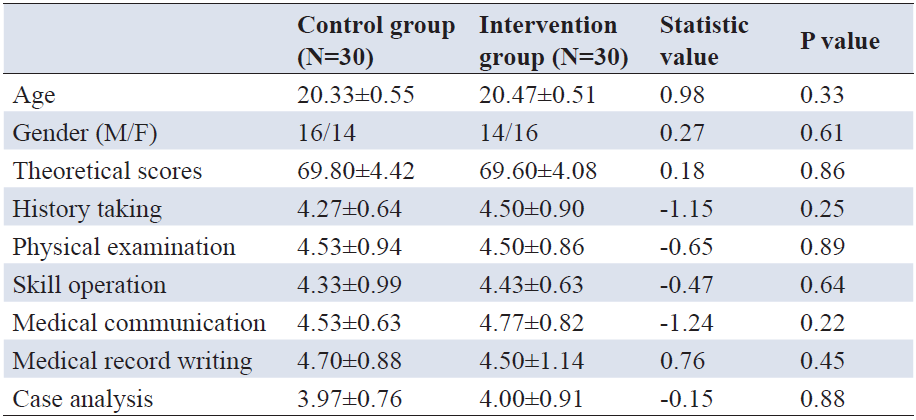
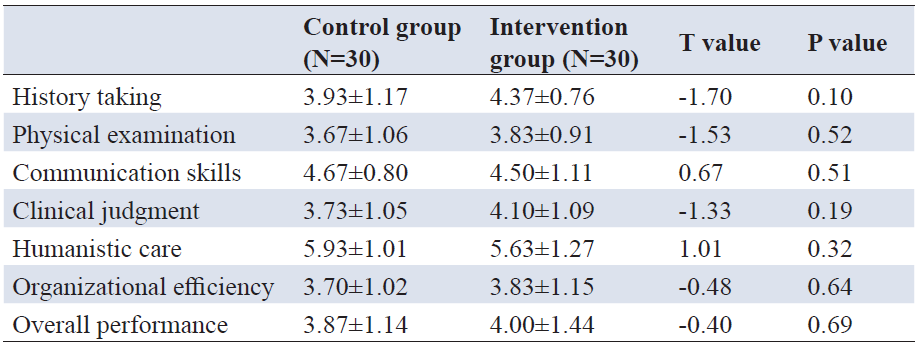
There were no statistically significant differences in the baseline characteristics between the two groups, including age, gender, and pretraining theoretical and practical skill scores, as shown in Table 1. There was no statistically significant difference in the Mini-CEX scores between the two groups of students, as shown in Table 2.

Table 1. Comparison of demographic data and baseline scores between the two groups
3.2 Primary outcome – Theoretical assessment
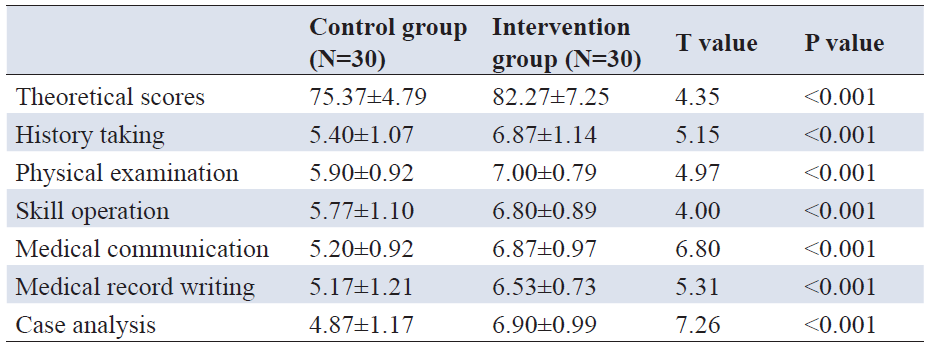
The intervention group scored significantly higher than the control group on the theoretical assessment (82.27±7.25 vs. 75.37±4.79, respectively; P<0.001) (Table 3).
3.3 Secondary outcomes – OSCE
The intervention group scored higher than the control group in history taking, physical examination, skill operation, medical communication, medical record writing, and case analysis (all P<0.05; detailed data are presented in Table 3).
3.4 Secondary outcomes – Mini-CEX scores
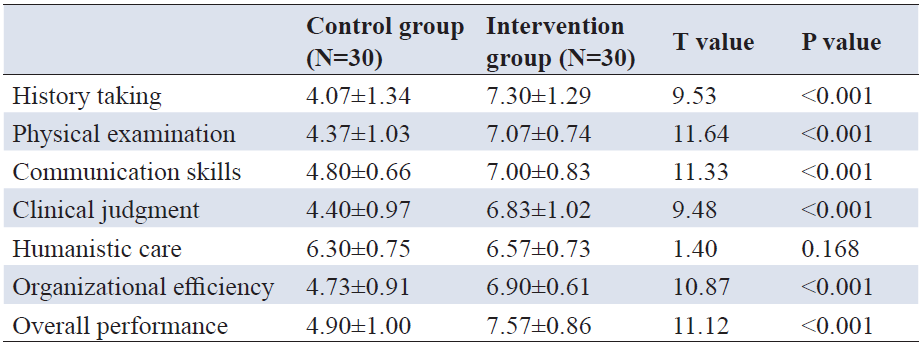
The intervention group demonstrated a significantly higher overall Mini-CEX score than the control group. Notably, the intervention group outperformed the control group in history taking, physical examination, communication skills, clinical judgment, and organizational efficiency (all P<0.05). However, no statistically significant difference was observed between the two groups in the aspect of humanistic care (P>0.05). See Table 4.
3.5 Secondary outcomes – Teaching satisfaction
No statistically significant difference was observed in the scores of teaching satisfaction between the two groups (4.50±0.57 vs. 4.63±0.56, P>0.05).
This study provides preliminary evidence for the effectiveness of an integrated teaching model combining the AGP with high-fidelity situational simulation in enhancing the diagnostic and therapeutic capabilities of residents for diabetes. Our findings demonstrate that this innovative approach significantly improved residents’ performance in theoretical assessments, OSCE stations including history taking, physical examination, and case analysis, and overall Mini-CEX scores, particularly in clinical judgment and organizational efficiency.
Glycemic monitoring is essential to diabetes management. Conventional self-monitoring of blood glucose provides only intermittent snapshots, failing to capture the full spectrum of daily glucose fluctuations. The advent of CGMS has transformed diabetes care by delivering continuous, comprehensive, and reliable 24-hour glycemic profiles. These data clearly outline glucose trends and can detect abnormalities often overlooked by conventional methods. Key CGMS-derived metrics, such as TIR, time below range, and coefficient of variation, are closely linked to the risk of both microvascular and macrovascular complications in diabetes [9]. For special populations, CGMS offers distinct advantages. In elderly patients, CGMS has been associated with reduced hypoglycemia and possibly fewer cardiovascular events [10]. In patients with GDM, the use of CGMS may offer several advantages, such as improving glycemic control, optimizing gestational weight management, enabling timely initiation of pharmacologic treatment, reducing the incidence of pre-eclampsia, and improving neonatal outcomes [11]. In patients with diabetes and advanced CKD, HbA1c is less reliable and hypoglycemia risk increased. CGMS overcomes the limitations of conventional monitoring by providing real-time glycemic trend data [12]. Furthermore, in adolescents with type 1 diabetes, CGMS promotes a sense of control and confidence through data visualization, thereby strengthening self-management and supporting better treatment outcomes [13]. Derived from CGMS data, the AGP serves not only as a visualization tool for refined diabetes management, but also as an ideal platform for cultivating blood glucose pattern recognition skills.
Scenario-based simulation education originated in high-risk professional training fields such as the military and aerospace industries [14]. This instructional strategy enables learners to practice complex skills without real risk. As a result, it has gained increasing attention in medical education and become a key method for training medical professionals [15, 16]. In medical education, scenario-based simulation refers to the use of various technical means to recreate realistic clinical environments, establishing a safe and reproducible learning setting to systematically enhance students’ comprehensive clinical competencies [17]. This teaching approach offers several advantages. Firstly, it generates highly realistic clinical scenarios, enabling learners to navigate diverse, intricate, and dynamic situations within an environment that closely mirrors actual practice. Secondly, it provides a controlled setting for rehearsal, allowing students to learn from errors without jeopardizing patient safety. Furthermore, scenario-based simulation promotes learning outcomes through immediate and guided feedback and permits the design of cases targeting rare or high-risk clinical events, thereby assisting students in mastering infrequent yet critical clinical skills. The eight typical clinical scenarios designed in this study were derived from real clinical challenges, covering different types, stages, and complication backgrounds of diabetes. Through simulation exercises, students learned how to interpret glucose profiles and practiced integrated competencies such as information synthesis, decision-making, communication, collaboration, and emergency response in a near-authentic environment. The superior performance of the experimental group in OSCE stations such as medical communication and procedural skills confirms the effectiveness of scenario-based simulation in enhancing clinical practice competency.
In the Mini-CEX assessment, the experimental group demonstrated significantly better performance than the control group in domains including history taking, clinical judgment, and organizational efficiency. However, no statistically significant difference was observed between the two groups in humanistic care. This finding suggests that while the integration of AGP and scenario simulation effectively strengthens data-driven analysis and clinical decision-making, it may have limited impact on nurturing softer competencies such as emotional support and empathetic communication. To address this gap, future teaching should enhance the emotional authenticity of simulated patient roles and incorporate dedicated humanistic care components into debriefing sessions.
Additionally, the study found no significant difference in teaching satisfaction between the groups. This could be due to the relatively small sample size, the subjective nature of satisfaction measures, or the need for a longer adjustment period to the innovative teaching model. Future post-course interviews could reveal learner acceptance, perceived workload, and suggestions for improving the teaching method.
This study has several limitations that warrant consideration. First, the single-center design and relatively small sample size may limit the generalizability of the findings. The participants were all from one institution, and their performance might not fully represent the broader population of internal medicine residents. Second, the assessment of teaching effectiveness was conducted immediately after the intervention, lacking long-term follow-up to evaluate the durability and sustainability of the acquired skills and knowledge. The persistence of improvements in clinical competency, such as blood glucose pattern recognition and complex scenario management, remains unknown. Third, while the assessment tools used in this study (OSCE, Mini-CEX) are widely accepted and validated instruments in medical education, we did not formally calculate inter-rater reliability for OSCE scores, nor did we conduct psychometric validation of the self-designed satisfaction questionnaire. The absence of these data may limit the reproducibility and internal validity of the measurement. However, all OSCE scorers and Mini-CEX assessors were blinded to group allocation and received standardized training on the assessment rubrics. Future studies should include formal reliability analyses, such as intraclass correlation coefficients for OSCE and generalizability studies for Mini-CEX, to strengthen the measurement rigor.
This study introduces an integrated model combining the AGP with high-fidelity scenario simulation for training resident physicians in diabetes diagnosis and management. Preliminary findings suggest that this innovative approach may address some limitations of traditional diabetes education in residency programs. Trainees showed improvements in theoretical knowledge and clinical skills compared with the control group. However, these results should be interpreted as exploratory, and further validation is needed. Future research should evaluate long-term clinical performance and sustained competency to further validate this teaching model. If effective, the model could support wider implementation and dissemination in diabetes education. It may also be adapted to other chronic disease training contexts.
Author contributions
Zhen Zhang: Conceptualization, Methodology, Formal Analysis, Writing Original Draft. Dan Liu: Methodology, Investigation, Data Curation, Formal Analysis. Lihong Niu: Data Collection, Statistical Analysis. Jiahao Tang: Investigation, Resources, Visualization, Data Curation. Xiahong Lin: Study Conception, Research Supervision. Peng Yun: Manuscript Revision, Project Coordination.
Funding
This work was supported by Teaching Quality Engineering Project of Sun Yat-sen University (78000-12253001).
Data availability
The data that support the findings of this study are available from the corresponding author upon reasonable request.
Ethics approval and consent to participate
This study was examined and approved by the Medical Research Ethics Committee of The Seventh Affiliated Hospital, Sun Yat-sen University (KY-2023-105-01). All participants provided written informed consent prior to enrollment.
Consent for publication
Not applicable.
Competing interests
The authors declare no competing interests.
Acknowledgements
The authors thank the standardized patients who participated in the simulation scenarios. We also thank the simulation center technicians for their assistance with the high-fidelity mannequins, and the departmental teaching coordinators for their help in scheduling the training sessions.
AI declaration
We used DeepSeek-V3.2 for language editing and grammar correction. All authors have reviewed and revised the manuscript and assume full responsibility for its final content.
[1] Duncan BB, Magliano DJ, Boyko EJ. IDF Diabetes Atlas 11th edition 2025: global prevalence and projections for 2050. Nephrol Dial Transplant. 2025 Dec 23;41(1):7-9. https://doi.org/10.1093/ndt/gfaf177
[2] Thomas D, Merrill K. Meeting theory-to-practice gaps? Evaluation of new graduates. J Nurses Prof Dev. 2023 Sep-Oct;39(5):E168-E173. https://doi.org/10.1097/NND.0000000000000847
[3] Joseph JI. Review of the long-term implantable senonesis continuous glucose monitoring system and other continuous glucose monitoring systems. J Diabetes Sci Technol. 2021 Jan;15(1):167-173. https://doi.org/10.1177/1932296820911919
[4] Jiang J, Pu D, Hu R, Hu M, Wu Q. Evaluation of the efficacy of the hospital glycemic management system for patients with malignant tumors and hyperglycemia. Diabetes Metab Syndr Obes. 2021 Jun 16;14:2717-2725. https://doi.org/10.2147/DMSO.S318435
[5] Gupta Y, Singh C, Goyal A, Mani K, Bharti J, Singhal S, et al. Continuous glucose monitoring system profile of women diagnosed as gestational diabetes mellitus by International Association of Diabetes and Pregnancy Study Groups criteria and labeled as normoglycemic by alternate criteria in early pregnancy. J Diabetes Investig. 2022 Oct;13(10):1753-1760. https://doi.org/10.1111/jdi.13865
[6] Zheng K, Shen Z, Chen Z, Che C, Zhu H. Application of AI-empowered scenario-based simulation teaching mode in cardiovascular disease education. BMC Med Educ. 2024 Sep 13;24(1):1003. https://doi.org/10.1186/s12909-024-05977-z
[7] Liao N, Scherzer R, Kim EH. Effective methods of clinical education. Ann Allergy Asthma Immunol. 2022 Mar;128(3):240-247. https://doi.org/10.1016/j.anai.2021.11.021
[8] Lio J, Ye Y, Dong H, Reddy S, McConville J, Sherer R. Standardized residency training in China: The new internal medicine curriculum. Perspect Med Educ. 2018 Feb;7(1):50-53. https://doi.org/10.1007/s40037-017-0378-5
[9] Battelino T, Alexander CM, Amiel SA, Arreaza-Rubin G, Beck RW, Bergenstal RM, et al. Continuous glucose monitoring and metrics for clinical trials: an international consensus statement. Lancet Diabetes Endocrinol. 2023 Jan;11(1):42-57. https://doi.org/10.1016/S2213-8587(22)00319-9
[10] Huang ES, Sinclair A, Conlin PR, Cukierman-Yaffe T, Hirsch IB, Huisingh-Scheetz M, et al. The growing role of technology in the care of older adults with diabetes. Diabetes Care. 2023 Aug 1;46(8):1455-1463. https://doi.org/10.2337/dci23-0021
[11] Salmen BM, Reurean-Pintilei D, Salmen T, Bohiltea RE. Exploring continuous glucose monitoring in gestational diabetes: A systematic review. Life (Basel). 2025 Aug 28;15(9):1369. https://doi.org/10.3390/life15091369
[12] Rhee CM, Gianchandani RY, Kerr D, Philis-Tsimikas A, Kovesdy CP, Stanton RC, et al. Consensus report on the use of continuous glucose monitoring in chronic kidney disease and diabetes. J Diabetes Sci Technol. 2025 Jan;19(1):217-245. https://doi.org/10.1177/19322968241292041
[13] Lagarde WH, Barrows FP, Davenport ML, Kang M, Guess HA, Calikoglu AS. Continuous subcutaneous glucose monitoring in children with type 1 diabetes mellitus: a single-blind, randomized, controlled trial. Pediatr Diabetes. 2006 Jun;7(3):159-164. https://doi.org/10.1111/j.1399-543X.2006.00162.x
[14] Robinson S, Ritchie A, Pacilli M, Nestel D, McLeod E, Nataraja RM. Simulation-based education of health workers in low- and middle-income countries: A systematic review. Glob Health Sci Pract. 2024 Dec 20;12(6):e2400187. https://doi.org/10.9745/GHSP-D-24-00187
[15] Ho M, Yu L, Lin P, Chang H, Traynor V, Huang W, et al. Effects of a simulation-based education programme on delirium care for critical care nurses: A randomized controlled trial. J Adv Nurs. 2021 Aug;77(8):3483-3493. https://doi.org/10.1111/jan.14938
[16] Bahattab A, Caviglia M, Martini D, Hubloue I, Della Corte F, Ragazzoni L. Scenario-based e-simulation design for global health education: Theoretical foundation and practical recommendations. J Med Internet Res. 2023 Oct 30;25:e46639. https://doi.org/10.2196/46639
[17] Barsness KA. Achieving expert performance through simulation-based education and application of mastery learning principles. Semin Pediatr Surg. 2020 Apr;29(2):150904. https://doi.org/10.1016/j.sempedsurg.2020.150904
ISSN: 3007-0007
Volume 2, Issue 2
September 2026

 Log In

 On This Page
 CITE
CITE