 Log In
Search




 Open Access
 lumeijing@yjsyy.com
Meijing Lu, Department of Anesthesiology, The First Affiliated Hospital of Wannan Medical College, No. 2 Zheshan West Road, Jinghu District, Wuhu 241001, Anhui, China. E-mail: lumeijing@yjsyy.com.
Received January 8, 2026; Accepted February 12, 2026; Published May 15, 2026
Open Accesslumeijing@yjsyy.comMeijing Lu, Department of Anesthesiology, The First Affiliated Hospital of Wannan Medical College, No. 2 Zheshan West Road, Jinghu District, Wuhu 241001, Anhui, China. E-mail: lumeijing@yjsyy.com.
Received January 8, 2026; Accepted February 12, 2026; Published May 15, 2026
Objective: To explore the application and effectiveness of a teaching method combining a distance teaching system with case-based learning (CBL) in clinical anesthesiology experimental teaching. This study aims to provide a reference for reforming practical teaching in the anesthesiology curriculum. Methods: Sixty undergraduate students majoring in anesthesiology from the Class of 2021 at Wannan Medical College were randomly divided into two groups. The control group (30 students) received traditional classroom teaching combined with a procedural demonstration. The observation group(30 students) was taught using the distance teaching system integrated with the CBL method. Epidural anesthesia was used as the teaching topic. After the course, the teaching effect was evaluated through a theoretical examination, a clinical skills assessment, and a satisfaction questionnaire. Results: The observation group scored significantly higher than the control group in both the theoretical knowledge examination (93.93±2.99 vs. 87.80±5.52) and the clinical skills assessment (90.43±8.88 vs. 82.73±6.65) (both P<0.05). Furthermore, the student satisfaction rate in the observation group (96.67%) was significantly higher than that in the control group (83.33%) (P<0.05). Conclusion: The combination of a distance teaching system and the CBL teaching method effectively addresses the common disconnect between clinical practice and experimental learning, as well as the limited operative view in traditional teaching. By integrating live broadcasts of real clinical scenarios with case-driven learning, this approach significantly enhances students' theoretical application ability, clinical operation skills, and learning satisfaction. This model offers a promising and scalable innovation for clinical anesthesiology experimental teaching.
Keywords: Case-based learning, Distance teaching system, Clinical anesthesiology, Experimental teaching
linical anesthesiology is a highly practical discipline [1, 2]. Core operations such as epidural puncture and endotracheal intubation must be adapted dynamically in real clinical scenarios based on individual patient conditions [3, 4]. Traditional practical teaching mostly follows a “theoretical explanation + model demonstration” model, which presents two prominent problems: first, the demonstration is constrained by the physical space and viewing perspective, preventing most students from clearly observing key details such as puncture positioning and drug administration timing; second, most teaching cases are derived from textbooks and are disconnected from real clinical anesthesia workflows and complication management, thus limiting the development of students’ clinical thinking [5, 6]. Although case-based learning (CBL) promotes active learning through case discussion and has been widely adopted across medical disciplines, most domestic studies still rely on text- and image-based cases [7, 8]. Although distance teaching systems can stream clinical procedures via high-definition live broadcast, when used alone they lack targeted case guidance and in-depth interaction, often resulting in passive viewing and limited learning outcomes [9, 10].
CBL is an educational model derived from integrating problem-based learning principles with clinical practice [11]. It guides students to carry out learning activities such as problem analysis, decision-making and solution formulation through real or fictional cases. This teaching method emphasizes students’ active participation and independent learning, and cultivates their problem-solving ability and thinking ability. However, in most current domestic studies on CBL education, the problems or cases in the teaching design are generally derived from textbook knowledge, and the cases used are usually sorted out by teachers and presented in words and pictures, which are different from the actual clinical anesthesia treatment process [12]. The distance surgical teaching system can transmit various clinical operations to the classrooms where students are located through high-definition cameras, enabling students to watch various operations and technical details of clinical anesthesiologists during the perioperative period in real time [13]. At the same time, students can also conduct real-time interaction with clinical anesthesiologists through the system, ask questions and get answers, so as to further promote communication and learning.
In recent years, foreign studies have attempted to combine distance technology with case teaching. Gupta et al. improved the skill retention rate of anesthesiology students through the “practical operation + case” mode, but there are still few systematic combined teaching studies targeting clinical anesthesiology experimental courses [14]. Therefore, this study integrates the live-scene transmission capability of the distance teaching system with the case-driven approach of CBL. Using epidural anesthesia as the instructional content, it investigates the effects of this combined model on students’ theoretical knowledge, clinical skills, and teaching satisfaction. The findings aim to provide an empirical foundation and practical strategies for reforming clinical anesthesiology education.
2.1 Research participants
Sixty undergraduate students majoring in anesthesiology (enrolled in 2021) at Wannan Medical College were recruited as participants. Using a random number table, they were equally divided into two groups: a control group (n=30) receiving traditional teaching, and an observation group (n=30) receiving instruction through the distance teaching system combined with CBL. The course content focused on the clinical anesthesiology experiment of epidural anesthesia. All instructors were physicians with intermediate or senior professional titles and had over five years of clinical teaching experience.
2.2 Teaching design and implementation
2.2.1 Control group
The traditional teaching method, namely classroom teaching + operation demonstration, was adopted. According to the content of the clinical anesthesiology experimental teaching syllabus, teachers explained the basic knowledge of epidural anesthesia, the operation steps of epidural puncture and related clinical anesthesia management knowledge in accordance with the experimental textbook. After watching the teacher’s operation demonstration, students completed the epidural puncture operation and filled in the experimental report.
2.2.2 Observation group
The distance teaching system combined with CBL teaching method was adopted.
(1) Case selection: Elective lower abdominal surgery patients in our hospital (American Society of Anesthesiologists grade Ⅰ-Ⅱ, aged 45-60 years) without epidural anesthesia contraindications were selected. The cases included teaching key points such as puncture space selection, anesthesia plane adjustment and hypotension prevention. Preoperative visits were completed and informed consent was obtained.
(2) Distance teaching system equipment: The operating room was equipped with 4K high-definition cameras (focusing on puncture sites and operation techniques) and wireless sound transmission equipment; the teaching room adopted high-definition projection (split-screen display of surgical operation pictures and case information) with a network bandwidth of ≥10 Mbps to ensure no delay in live broadcast.
(3) CBL problem design: Core questions were preset around the teaching syllabus: ① What is the optimal space for epidural puncture in this patient and its anatomical basis? ② What are the treatment principles when cerebrospinal fluid reflux occurs during puncture? ③ What are the causes and coping measures for hypotension when the anesthesia plane reaches T6? ④ What are the differences in clinical application between epidural anesthesia and spinal anesthesia?
(4) Teaching implementation: Before class, students in the teaching room were divided into 5 groups (6 students in each group), and each group was assigned a student with solid professional basic knowledge, active thinking and strong communication ability to play a leading role. According to the CBL teaching method, teachers live broadcasted the perioperative anesthesia management and corresponding operations of the selected cases according to the course arrangement, guided students and put forward case-related questions, and students analyzed the current cases through group discussion. At the same time, students in the teaching room carried out simulation training synchronously, following the operations of the teachers in the operating room, and the instructors in the teaching room assisted in solving the problems encountered by students and answering questions.
2.3 Evaluation of teaching effectiveness
After the experimental course, the teaching effects of the two teaching methods in this study were evaluated by an epidural-related theoretical knowledge examination, a clinical operation skill assessment, and a teaching satisfaction questionnaire [15]. Both the theoretical knowledge examination and clinical skill assessment scores were based on 100 points. The content of the clinical operation skill assessment was epidural puncture, and the clinical operation ability of medical students was scored by the instructors in the teaching room. The teaching method satisfaction questionnaire was filled out anonymously by all students.
2.3.1 Theoretical knowledge examination
The duration was 90 minutes. The question types and scores were as follows: multiple-choice questions (30 questions, 1 point each), short-answer questions (4 questions, 10 points each), and case analysis questions (1 question, 30 points). The assessment content covered the anatomical basis, operation process, drug selection, complication management of epidural anesthesia, etc.
2.3.2 Clinical skill assessment
Taking epidural puncture as the core, the scoring criteria are shown in Table 1. Two senior physicians scored independently and blindly, and the average value was taken as the final score. To ensure the validity of the assessment tool, the scoring criteria (Table 1) were formulated based on the “Clinical anesthesiology experimental teaching guidelines” issued by the Chinese Medical Association, combined with the core operational requirements of epidural anesthesia in clinical practice. The criteria were reviewed and revised by 3 senior anesthesiologists with more than 10 years of clinical and teaching experience to confirm their relevance and comprehensiveness to the teaching objectives. For inter-rater reliability, the two senior physicians responsible for scoring received unified training before the assessment: they jointly reviewed 5 sets of standard operation videos of epidural puncture, calibrated the scoring standards item by item, and resolved differences in judgment through group discussion. The intraclass correlation coefficient of the two assessors was calculated as 0.92 (95% confidence interval: 0.86-0.96), indicating excellent inter-rater consistency.


2.3.3 Teaching satisfaction questionnaire
This questionnaire was self-designed based on the research objectives and relevant literature, aiming to comprehensively evaluate students’ recognition of the teaching method [16]. The content framework was constructed around 4 core dimensions closely related to experimental teaching effectiveness: practicality of teaching content, interactivity of teaching process, help in skill improvement, and stimulation of learning interest, with 2 items under each dimension (8 items in total). To ensure content validity, the initial questionnaire was reviewed by 3 senior professors in the field of medical education and 2 clinical anesthesiologists with more than 10 years of teaching experience. Their suggestions on the clarity, rationality and relevance of the items were adopted to revise ambiguous expressions and adjust the logical order of questions. The content validity index of the final questionnaire was 0.93, indicating good content validity. Before formal application, a pre-survey was conducted among 20 anesthesiology undergraduate students from the Class of 2020 (not included in the formal research objects) to test the reliability of the questionnaire. The Cronbach’s α coefficient of the total questionnaire was 0.87, and the Cronbach’s α coefficients of the four dimensions were 0.82 (practicality), 0.85 (interactivity), 0.83 (skill improvement) and 0.81 (learning interest), respectively, all >0.7, confirming that the questionnaire had good internal consistency. The questionnaire adopted a 5-point Likert scale (1 = very dissatisfied, 2 = dissatisfied, 3 = neutral, 4 = satisfied, 5 = very satisfied). A total score of ≥4 points was defined as “satisfied” to calculate the overall satisfaction rate. All students filled in the questionnaire anonymously after the course to ensure the authenticity of the data.
2.4 Statistical methods
SPSS 26.0 software was used for statistical analysis of data. Measurement data were expressed as mean ± standard deviation, and t-test was used for intergroup comparison. Count data were expressed as n (%), and χ² test was used for intergroup comparison. P<0.05 was considered statistically significant.
3.1 Comparison of general data between the two groups
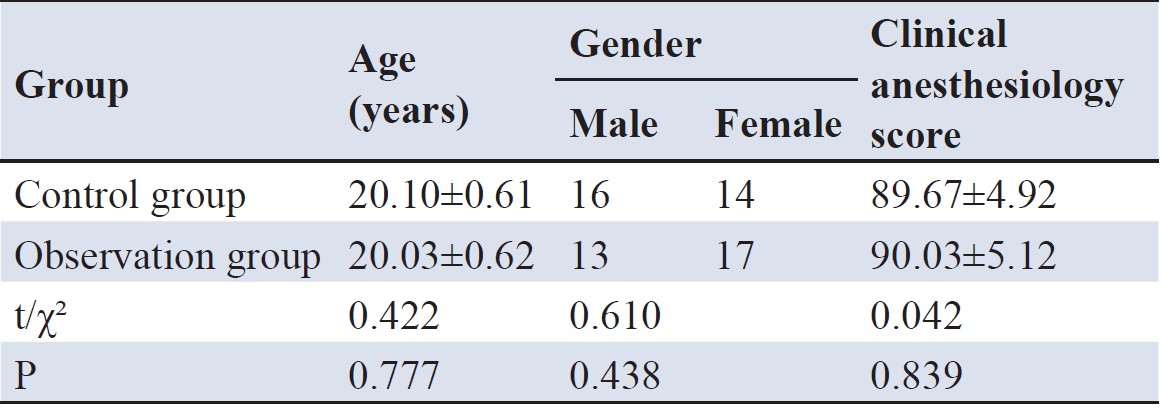
In the observation group, there were 30 students, including 13 males and 17 females, aged 19-23 years, with an average age of (20.03±0.62) years. In the control group, there were 30 students, including 16 males and 14 females; aged 19-23 years, with an average age of (20.10±0.61) years. There were no statistically significant differences in age, gender, professional course scores and other aspects between the two groups of students (all P>0.05), and the data were comparable (see Table 2).
Table 2. Comparison of general information between the two groups of students
3.2 Theoretical knowledge examination scores and clinical operation skill assessment scores
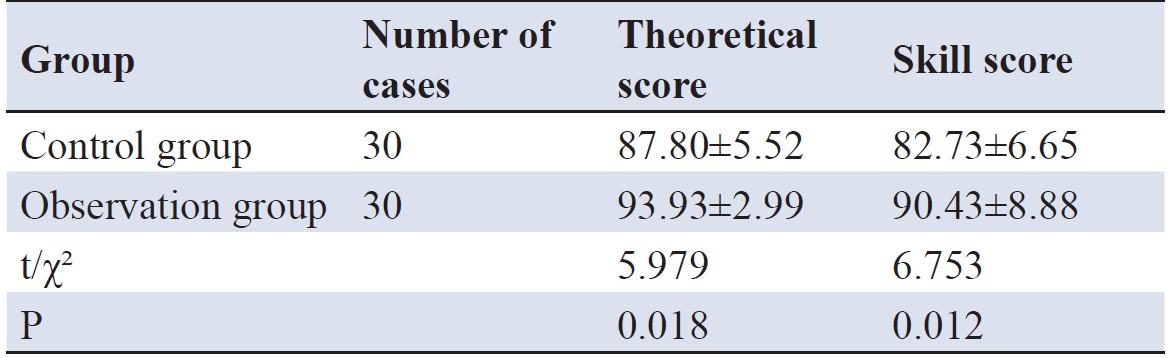
The assessment results showed that the theoretical examination scores and clinical operation skill assessment scores of the students in the distance teaching system combined with CBL teaching method group were significantly higher than those in the traditional teaching method group (93.93±2.99 vs. 87.80±5.52; 90.43±8.88 vs. 82.73±6.65) (both P<0.05) (see Table 3).
Table 3. Comparison of examination scores between the two groups of students
3.3 Results of student satisfaction survey
The questionnaire results showed that the average scores of the observation group in the four dimensions of practicality of teaching content, interactivity, help in skill improvement and stimulation of learning interest were significantly higher than those of the control group (all P<0.05) (see Table 4). The overall satisfaction rate of the observation group was 96.67% (29/30), and that of the control group was 83.33% (25/30), with a statistically significant difference (χ²=9.387, P=0.009).

Note: Overall satisfaction rate = (number of very satisfied + basically satisfied cases)/total number of cases × 100%; each dimension adopts a 5-point Likert scale (1 = very dissatisfied, 5 = very satisfied).
As a discipline emphasizing the combination of theory and practice, clinical anesthesiology covers a variety of complex clinical operations such as endotracheal intubation, nerve block and central venous catheterization in its teaching content [17, 18]. In the teaching of anesthesiology, simulation training is widely used to improve students’ clinical skills [19]. Simulation training provides a safe environment for students to practice and master complex operational skills without endangering patient safety [19]. Studies have shown that simulation training can significantly improve the skill level of anesthesiologists and help improve the quality of patient care [20]. In summary, the teaching of clinical anesthesiology not only requires solid theoretical knowledge but also needs to improve students’ practical operation ability through various methods such as simulation training and anatomy courses. This comprehensive teaching method helps to cultivate more qualified anesthesiology professionals.
The CBL teaching method is an instructional approach that is problem-based and involves students discussing and learning around actual clinical cases [11]. In CBL teaching, students will discuss in groups, and the instructor will guide and promote communication and cooperation among students [12]. By discussing and analyzing actual cases, students can gradually improve their ability to independently solve clinical problems. However, a limitation of relying solely on the CBL teaching method is that students may focus excessively on the cases themselves, leading to inconsistencies between the teaching content and actual clinical operations. This can result in a disconnect between laboratory teaching and clinical practice.
The application of the distance teaching system not only improves communication between teachers and students but also deepens students’ understanding of abstract concepts and theories in textbooks, which is essential for medical students when they enter the clinical learning stage in the future. This study combines the distance teaching system with the CBL teaching model. Through videos, students can observe real patients and anesthesia scenarios, and the anesthesiologist’s perspective shows every step of the anesthesia process completely and clearly to students, enabling them to fully understand the clinical anesthesia procedures and operation points. This learning method creates an interactive learning community by combining information technology with the teaching environment, allowing students to transform from passive learning to active knowledge construction, thereby improving learning outcomes.
The results of this study showed that the theoretical examination scores and clinical operation skill assessment scores of students in the distance teaching system combined with CBL teaching method group were significantly higher than those in the traditional teaching method group, with statistically significant differences (both P<0.05). These findings indicate that the combination of distance teaching system and CBL teaching method can improve the quality of experimental teaching for medical students and make clinical anesthesiology experimental teaching closer to clinical internship teaching. This study is consistent with the research of Fang et al., in which students’ operation skill scores were significantly improved through the application of distance live broadcast in anesthesiology teaching [13]. However, this study further integrated the CBL teaching method, added case-driven in-depth interaction, and resulted in a more significant improvement in satisfaction rate (96.67% vs. 88.2% in their research). Wen et al. found in oncology teaching that the CBL teaching method can improve students’ problem-solving ability, but due to the lack of real operation scene support, the effect on skill improvement is limited [21]. This study supplemented the operation scene through distance teaching, achieved a closed-loop of “theory - case - operation”, and further verified the advantages of the combined model in teaching practical disciplines.
The results of this study showed that through the combination of distance teaching system and CBL teaching method, students’ satisfaction was significantly higher than that of the traditional teaching method group. The flexibility and convenience of the distance teaching system allow students to learn according to their own pace and schedule, reducing time pressure and restrictions. Studies have shown that the CBL teaching model has significant value in improving the achievement rate, practical ability, and psychological quality of medical students [7]. By observing students’ actions and expressions during internships to evaluate their psychological quality, and using questionnaires to assess their performance in future planning, occupational health, and team spirit, the results showed that the CBL teaching model significantly improved the training compliance rate of medical students and enhanced their confidence in future role transitions to a certain extent.
This study has certain limitations: ① The sample size is small (60 students) and only from a single college, which may introduce selection bias. In the future, the sample size needs to be expanded to multiple colleges of different levels to further verify the generalizability of the research results; ② This model has shown certain advantages in small-class teaching (30 students). However, in large-class teaching, it may face difficulties in organizing group discussions and reduced interaction efficiency; ③ The implementation of the distance teaching system relies heavily on a stable network and advanced technical support. When the network is unstable or technical failures occur, this dependence may lead to interruptions or degradation in the quality of clinical skill teaching; ④ The distance teaching system is becoming increasingly popular in medical education, especially in the context of the global epidemic.
In conclusion, the application of the distance teaching system combined with the CBL teaching method in clinical anesthesiology experimental teaching can significantly improve the teaching effect and students’ satisfaction by providing high-quality content and an interactive learning environment. This approach further enriches the traditional teaching system, effectively stimulates students’ interest in independent learning, and helps cultivate anesthesiology professionals who meet clinical requirements.
Author contributions
Huaichang Wen conceived the research idea, designed the study protocol, collected and analyzed the research data, and completed the drafting of the original manuscript. Yi Wang participated in the design of this study, carried out the teaching practice and implementation work, assisted in data collation, and critically revised the manuscript to polish its core intellectual content. Kaichen Zhang completed the statistical analysis of research data, participated in the formulation of teaching evaluation tools, and enriched and improved the discussion section of the article. Wenjun Guo assisted in organizing the teaching practice, collected feedback information from teachers and students, and verified the accuracy of all experimental data in this study. Meijing Lu supervised the whole process of the research, provided professional academic guidance for teaching design, revised and finalized the manuscript for official submission, and ensured the overall integrity and standardization of the research.
Funding
This work was supported by the School-level Quality Engineering Project of Wannan Medical College (2022jyxm38) and the Anhui Province Quality Engineering Project of Colleges and Universities (2023jyxm0674).
Data availability
The data that support the findings of this study are available from the corresponding author upon reasonable request.
Ethics approval and consent to participate
This study was exempted from ethical review by the Ethics Committee of Wannan Medical College, because the research was a non-invasive educational teaching reform study, no human biological samples or confidential clinical data were involved, and all participants’ information was kept anonymous.
Consent for publication
All authors have reviewed and approved the final manuscript.
Competing interests
The authors declare that they have no competing interests.
Acknowledgements
Not applicable.
[1] Cannesson M, Schwid H, Rinehart J, Kain Z. Technology, social engineering, and clinical anesthesiology: Present and future. Anesth Analg. 2015 Sep;121(3):591-593. https://doi.org/10.1213/ANE.0000000000000668
[2] Goldstein S, Bryan A, Vick AK, Straker T, Ramachandran S. The case for modernizing the third-year clinical anesthesiology residency curriculum. J Educ Perioper Med. 2021 Oct 1;23(4):E673. https://doi.org/10.46374/volxxiii_issue4_goldstein
[3] Yin H, Tong X, Huang H. Dural puncture epidural versus conventional epidural analgesia for labor: A systematic review and meta-analysis of randomized controlled studies. J Anesth. 2022 Jun;36(3):413-427. https://doi.org/10.1007/s00540-022-03061-8
[4] Chau A, Tsen LC. Neuraxial initiation techniques for labor analgesia: Comparative insights on standard epidural, combined spinal-epidural and dural puncture epidural analgesia. Curr Opin Anaesthesiol. 2025 Jun 1;38(3):195-201. https://doi.org/10.1097/aco.0000000000001487
[5] Miao C, Huang Y, Duan Q, Mao Y, Chen J, Li Y, et al. Construction of research feedback experimental teaching mode for medical undergraduate students and comparative study with traditional experimental teaching mode. BMC Med Educ. 2025 Jul 1;25(1):961. https://doi.org/10.1186/s12909-025-07538-4
[6] Meng L, Liu X, Ni J, Shen P, Jiao F. An investigation for the efficacy of teaching model of combining virtual simulation and real experiment for clinical microbiology examination. Front Med (Lausanne). 2024 Feb 21;11:1255088. https://doi.org/10.3389/fmed.2024.1255088
[7] Xu L, Lin C, Hou C, Li S. The combined BOPPPS and CBL teaching method enhances students' learning in pathology experimental course. Adv Physiol Educ. 2025 Jun 1;49(2):526-534. https://doi.org/10.1152/advan.00154.2024
[8] Cen X, Hua Y, Niu S, Yu T. Application of case-based learning in medical student education: A meta-analysis. Eur Rev Med Pharmacol Sci. 2021 Apr;25(8):3173-3181. https://doi.org/10.26355/eurrev_202104_25726
[9] Lo Presti V. The social impact of distance learning in Roman schools: "Success," social innovation, teaching practices. Front Sociol. 2023 Apr 5;8:1141435. https://doi.org/10.3389/ fsoc.2023.1141435
[10] Tseng C, Wang C, Hsu C, Liu J. Behavioral intention to use distance teaching in the pandemic era. Front Psychol. 2022 Aug 11;13:879316. https://doi.org/10.3389/fpsyg.2022.879316
[11] Chen D, Zhao W, Ren L, Tao K, Li M, Su B, et al. Digital PBL-CBL teaching method improves students' performance in learning complex implant cases in atrophic anterior maxilla. PeerJ. 2023 Dec 6;11:e16496. https://doi.org/10.7717/peerj.16496
[12] Li H, Qin Q. The application of CBL combined with MDT teaching mode in emergency nursing teaching. Minerva Med. 2024 Jun 13. https://doi.org/10.23736/s0026-4806.24.09319-4
[13] Fang S, Li M, Zhang C, Cheng H, Zhang K, Bao P, et al. Application of distant live broadcast in clinical anesthesiology teaching. Am J Transl Res. 2022 Mar 15;14(3):2073-2080.
[14] Gupta N, Kabra P, Mandal S, Gupta A, Sarma R, Malhotra RK. Comparative evaluation of King Vision videolaryngoscope channeled and non-channeled blades with direct laryngoscope for intubation performance and skill retention by medical students: A randomized cross over two period study. J Clin Monit Comput. 2023 Apr;37(2):541-547. https://doi.org/10.1007/s10877-022-00919-w
[15] Falahan SN, Habibi E, Kamyari N, Yousofvand V. Impact of virtual problem-based learning of cardiopulmonary resuscitation on fourth-year nursing students' satisfaction and performance: A quasi-experimental study. BMC Med Educ. 2024 Apr 19;24(1):425. https://doi.org/10.1186/s12909-024-05375-5
[16] Aslan KT, Ay P, Kaş D, Tosun F, Yürükcü İ, Kekeç E, et al. Adaptation and validation of the turkish version of the vaccine hesitancy 5 point likert scale. Hum Vaccin Immunother. 2021 Dec 2;17(12):5176-5182. https://doi.org/10.1080/21645515.2021.1953347
[17] Chen F, Teeter E, Gaona AR, Isaak R. Exploring how gender and race are related to the alignment of anesthesiology residents' self-assessments and faculty evaluation of clinical competencies. J Educ Perioper Med. 2025 Oct 24;27(3):E748. https://doi.org/10.46374/VolXXVII_Issue3_Chen
[18] de Graaff JC, Johansen MF, Hensgens M, Engelhardt T. Best practice & research clinical anesthesiology: Safety and quality in perioperative anesthesia care. Update on safety in pediatric anesthesia. Best Pract Res Clin Anaesthesiol. 2021 May;35(1):27-39. https://doi.org/10.1016/j.bpa.2020.12.007
[19] Rothkrug A, Mahboobi SK. Simulation training and skill assessment in anesthesiology [Internet]. Treasure Island (FL): StatPearls Publishing; 2023 [updated 2023 May 1; cited 2026 Jan 6]. Available from: https://www.ncbi.nlm.nih.gov/books/NBK557711/
[20] Daly Guris RJ, George P, Gurnaney HG. Simulation in pediatric anesthesiology: Current state and visions for the future. Curr Opin Anaesthesiol. 2024 Jun 1;37(3):266-270. https://doi.org/10.1097/aco.0000000000001375
[21] Wen F, Mo J, Li R. Application value of multi-disciplinary collaborative diagnosis and treatment combined with CBL teaching model in gynecological oncology practice teaching. Front Med (Lausanne). 2025 Jan 8;11:1468256. https://doi.org/10.3389/fmed.2024.1468256
ISSN: 3007-0007
Volume 2, Issue 1
April 2026
Pages: 1-63


 Log In

 On This Page
 CITE
CITE