 Log In
Search




 Open Access
 jwang23@MGH.Harvard.edu
Jingping Wang, Department of Anesthesia, Critical Care and Pain Medicine, Massachusetts General Hospital, Harvard Medical School, 55 Fruit Street, Boston, MA 02114, USA. Tel: (+1) 617-643-2729. ORCID: 0000-0003-2699-1650. E-mail: jwang23@MGH.Harvard.edu.
Open Accessjwang23@MGH.Harvard.eduJingping Wang, Department of Anesthesia, Critical Care and Pain Medicine, Massachusetts General Hospital, Harvard Medical School, 55 Fruit Street, Boston, MA 02114, USA. Tel: (+1) 617-643-2729. ORCID: 0000-0003-2699-1650. E-mail: jwang23@MGH.Harvard.edu.
Intellectual disability (ID) is a neurodevelopmental condition affecting 1–2% of the global population [1]. Individuals with ID often encounter substantial barriers to healthcare and experience a disproportionately high burden of oral disease. Anxiety, limited cooperation, and emergence delirium are common during dental procedures, and these issues are frequently magnified in patients with ID because of communication difficulties and behavioral dysregulation [2].
The anesthetic approach to dental procedures ranges from local anesthesia to deep sedation or general anesthesia, depending on procedural complexity and patient cooperation [3]. Although general anesthesia is effective and generally safe when performed with appropriate monitoring and expertise, concerns remain regarding respiratory complications, recovery burden, resource utilization, and repeated exposure in vulnerable patients [4].
Dexmedetomidine, a highly selective α2-agonist, produces a sedative state resembling natural sleep while providing anxiolytic and analgesic effects with minimal respiratory depression [5]. Current evidence supporting the use of dexmedetomidine in dental surgery is derived from pediatric, adult, and a limited number of ID-specific studies, many of which employ heterogeneous protocols and outcome measures. This variability complicates definitive conclusions and underscores the need for a focused synthesis of available data.
This Perspective examines the role of dexmedetomidine in dental surgery, with particular emphasis on patients with ID. Evidence from both pediatric and adult surgical settings is integrated to provide a broad clinical perspective. By reviewing its pharmacological characteristics, clinical applications, and comparisons with other commonly used sedatives, this article aims to inform anesthetic decision-making and highlight priorities for future research in this underrepresented population.
Dexmedetomidine is a highly selective α2-adrenergic receptor agonist that produces sedation, anxiolysis, and analgesia primarily by inhibiting norepinephrine release in the locus coeruleus. Perioperative suppression of sympathetic nervous system activity may manifest as reductions in heart rate and blood pressure, largely through decreased central sympathetic outflow, altered peripheral vascular resistance, and reduced cardiac output, underscoring the need for close hemodynamic monitoring during administration. This mechanism results in a state of cooperative sedation that closely resembles natural sleep, allowing patients to remain arousable while minimizing respiratory depression [6]. Unlike γ-aminobutyric acid type A receptor modulators such as benzodiazepines, dexmedetomidine maintains respiratory drive, which is particularly advantageous for patients at risk of airway compromise [7].
In healthy adult volunteers receiving intravenous dexmedetomidine, a rapid distribution phase and an elimination half-life of approximately 2–3 hours have been reported [8]. Dexmedetomidine is mainly metabolized via glucuronidation, with minor cytochrome P450 (CYP) involvement including CYP2A6. Although clinically significant interactions are not well established, enzyme-inducing antiepileptics such as carbamazepine and phenytoin may theoretically affect clearance or sedation response, warranting consideration in patients on chronic antiepileptic therapy [9].
Dexmedetomidine can be administered orally, intranasally, intramuscularly, or intravenously, depending on patient cooperation and clinical context. Oral premedication is often preferred for cooperative patients, while intranasal delivery provides a noninvasive alternative for uncooperative patients [10]. For short-term sedation in intensive care settings, the recommended intravenous regimen includes a loading dose of 1 μg/kg over 10 minutes followed by a maintenance infusion of 0.2–0.7 μg/kg/h. It is important to note, however, that only the intravenous route is U.S. Food and Drug Administration-approved (Precedex®); oral and intranasal uses remain off-label.
Dexmedetomidine has been increasingly explored as a premedication for anxiolysis and induction facilitation in both pediatric and special-needs patients, with growing interest in its clinical application. Its cooperative sedative effect facilitates separation from caregivers, venous cannulation, and inhalational induction, while reducing agitation and maintaining respiratory safety. During surgery, dexmedetomidine may offer hemodynamic stability, opioid-sparing effects, and relatively limited respiratory depression, though individual responses can vary. Postoperatively, dexmedetomidine may help reduce the incidence of nausea, vomiting, agitation, and airway events, potentially supporting a smoother recovery, particularly in selected vulnerable populations, although evidence in patients with ID specifically remains limited.
4.1 Pediatric and adult oral and maxillofacial surgery
Pediatric dental studies suggest that dexmedetomidine, administered orally or intranasally, may improve preoperative cooperation, mask acceptance, and perioperative recovery quality. A meta-analysis reported benefits in preoperative sedation and emergence delirium compared with placebo or midazolam, without a clear increase in major respiratory adverse events in most studies [11]. Dexmedetomidine has also been explored as an alternative premedication in children with autism undergoing dental treatment [12]. Although these findings support its potential value in pediatric dental sedation, the available evidence is only indirectly applicable to patients with ID.
In adult oral and maxillofacial surgery, dexmedetomidine may provide sedative, analgesic, and sympatholytic benefits. Liu et al. reported that perioperative dexmedetomidine infusion reduced postoperative pain scores and improved subjective sleep quality in elderly patients, although it did not significantly reduce postoperative delirium [13]. The absence of a significant benefit may be related to the multifactorial nature of delirium in older adults, as well as potential limitations in dosing, timing, and perioperative exposure to dexmedetomidine. Taylor et al. found that adding dexmedetomidine to intravenous sedation for outpatient dentoalveolar surgery was associated with stable sedation levels, lower heart rate and blood pressure, and preserved respiratory function, with comparable recovery profiles [14]. Overall, adult studies suggest that dexmedetomidine may improve perioperative comfort and hemodynamic stability, but its benefits for complex outcomes such as delirium remain uncertain.
4.2 Patients with intellectual disabilities
Children with ID often display heightened preoperative anxiety, sensory sensitivities, and poor cooperation, making pharmacologic premedication essential. Individuals with ID, including those with co-occurring autism spectrum disorder, pose additional anesthetic challenges due to communication barriers, tactile sensitivities, and behavioral dysregulation. Although studies in this population are limited, evidence supports the utility of dexmedetomidine. Tanaka et al. (2024) reported successful intranasal administration (1.5 μg/kg) in an adult patient intolerant of oral midazolam, allowing smooth sevoflurane mask induction [15]. Lubisch et al. (2009) evaluated 315 pediatric patients with autism and other neurobehavioral disorders, achieving 98.7% sedation success with minimal cardiovascular intervention or airway events [16]. Akhavan et al. (2022) assigned 50 adults with ID undergoing dental or maxillofacial surgery to dexmedetomidine infusion (2 μg/kg/h) versus control. The drug improved hemodynamic stability, reduced postoperative agitation, and did not delay recovery [17]. Cant et al. (2023) similarly observed effective sedation and low opioid requirements in 16 children with autism receiving dexmedetomidine premedication [12]. Collectively, these preliminary findings suggest that dexmedetomidine may be a potentially useful sedation option for selected patients with intellectual disabilities, although the evidence base remains small, heterogeneous, and largely indirect. Definitive conclusions regarding its safety and efficacy in this population await larger, well-designed prospective studies.
4.3 Practical considerations and future directions
Effective dexmedetomidine dosing depends on the route of administration and patient characteristics. Oral doses typically range from 1–4 μg/kg, while intranasal administration at 2 μg/kg reliably achieves sedation in pediatric patients. Intravenous use generally involves a loading dose of 0.5–1 μg/kg followed by a maintenance infusion of 0.2–0.7 μg/kg/h. Continuous monitoring of respiratory and cardiovascular parameters is essential, particularly during intravenous administration. Sedation and behavioral scoring systems can help guide titration and optimize patient cooperation. Integrating dexmedetomidine into multimodal anesthetic regimens can reduce reliance on opioids and benzodiazepines, contributing to smoother recoveries and fewer respiratory complications. Nevertheless, individual responses vary, and clinicians should remain vigilant for bradycardia and hypotension.
Future research should move beyond broad evaluations of dexmedetomidine in mixed procedural sedation populations and focus specifically on dental patients with ID. Multicenter prospective trials are needed, ideally comparing dexmedetomidine-based regimens with commonly used alternatives such as midazolam, propofol, ketamine, or combination protocols. Importantly, future studies should prespecify stratified analyses by comorbidity profile, including autism spectrum disorder-associated ID, Down syndrome, cerebral palsy, epilepsy, obstructive sleep apnea, congenital heart disease, and chronic psychotropic medication use. Such designs would help determine not only whether dexmedetomidine is effective, but also which subgroups are most likely to benefit and which may be at risk of adverse effects.
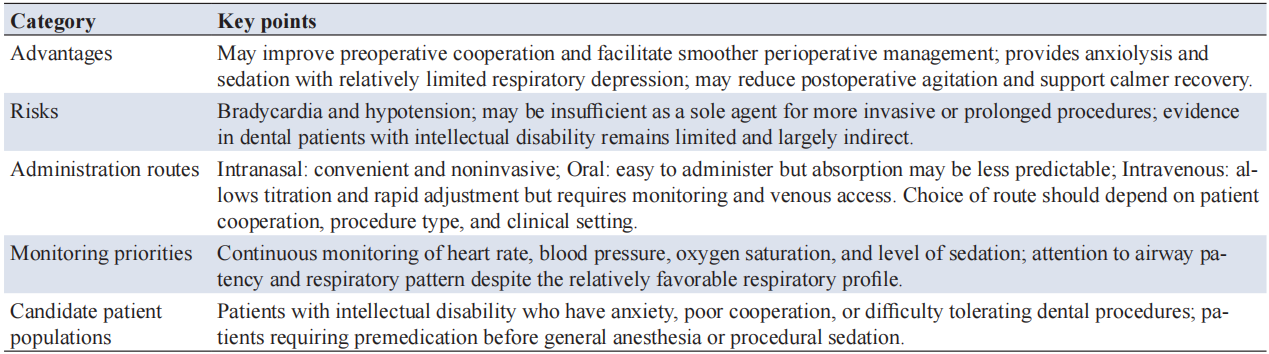
Table 1 summarizes practical clinical considerations for the use of dexmedetomidine in dental patients with ID. These considerations are based on limited direct evidence, selected indirect evidence, and clinical interpretation, and should not be interpreted as definitive practice recommendations.

Dexmedetomidine is a sedative agent with a mechanistically distinct profile and several pharmacological advantages that have been evaluated across various oral and maxillofacial surgery contexts. Its ability to provide cooperative sedation while largely preserving respiratory function may be particularly advantageous for children and selected patients with intellectual disabilities, although hemodynamic effects such as bradycardia and hypotension require careful monitoring. Current evidence suggests that dexmedetomidine may have potential as a sedative adjunct for selected dental procedures because of its anxiolytic profile, facilitation of perioperative cooperation, and limited respiratory depressant effects. However, evidence specifically addressing patients with ID undergoing dental treatment remains limited, indirect, and heterogeneous. Importantly, ID represents a highly diverse clinical population with substantial variability in cognitive function, behavioral phenotype, communication ability, sensory sensitivity, comorbidity burden, and perioperative risk profile. Accordingly, dexmedetomidine use in this setting should be individualized to patient characteristics, procedure complexity, airway considerations, and institutional expertise rather than applied through a uniform sedation approach. Future research should move beyond generalized evaluations of sedative efficacy and focus on precision-oriented perioperative strategies for special-needs populations.
Author contributions
Yilin Liu contributed to the study conception, literature search, and manuscript drafting. Mingyue Li performed literature screening, and contributed to manuscript drafting and revision. Sarah Ahmed and Meikun Wang revised the manuscript. Jingping Wang supervised the study, provided overall guidance on study design and clinical interpretation, and critically revised the manuscript. All authors reviewed and approved the final manuscript.
Funding
This work was supported by Jilin Provincial Natural Science Foundation (YDZJ202401458ZYTS)
Data availability
Not applicable.
Ethics approval and consent to participate
Not applicable.
Consent for publication
Not applicable.
Competing interests
The authors declare that they have no competing interests.
Acknowledgements
Not applicable.
[16] Lubisch N, Roskos R, Berkenbosch JW. Dexmedetomidine for procedural sedation in children with autism and other behavior disorders. Pediatr Neurol. 2009 Aug;41(2):88-94. https://doi.org/10.1016/j.pediatrneurol.2009.02.006
[17] Akhavan A, Tabesh M, Kaviani N, Feizi G. The effect of dexmedetomidine on blood pressure and recovery conditions of intellectually disabled adults undergoing dental treatment with general anaesthesia: A double-blinded randomized clinical trial. J Pharm Negat Results. 2022 Jul 1;13(Special Issue 7):8056-8062. https://doi.org/10.47750/pnr.2022.13.S07.975
ISSN: 2957-5443
Volume 4, Issue 3
September 2026
Pages: 278-374


 Log In

 On This Page
 CITE
CITE