 Log In
Search




 Open Access
 Crystalleichong@126.com
Lberra@mgh.harvard.edu
Crystalleichong@126.com
Lberra@mgh.harvard.eduChong Lei, Department of Anesthesiology and Perioperative Medicine, Xijing Hospital, 127 West Changle Road, Xincheng District, Xi’an 710032, Shaanxi, China. E-mail: Crystalleichong@126.com. Lorenzo Berra, Department of Anesthesia, Critical Care and Pain Medicine, Massachusetts General Hospital, 55 Fruit Street, WHT 437, Boston, MA 02114, USA. E-mail: Lberra@mgh.harvard.edu.
Open AccessCrystalleichong@126.comLberra@mgh.harvard.eduChong Lei, Department of Anesthesiology and Perioperative Medicine, Xijing Hospital, 127 West Changle Road, Xincheng District, Xi’an 710032, Shaanxi, China. E-mail: Crystalleichong@126.com. Lorenzo Berra, Department of Anesthesia, Critical Care and Pain Medicine, Massachusetts General Hospital, 55 Fruit Street, WHT 437, Boston, MA 02114, USA. E-mail: Lberra@mgh.harvard.edu.
For decades, clinicians have used inhaled nitric oxide (iNO) as a rescue strategy for the management of pulmonary hypertension (PH) and right ventricular (RV) failure [1]. Nitric oxide has long been valued for its rapid onset and unique selectivity. It dilates ventilated lung units without causing systemic hypotension. Even so, despite an increase in its use, the application of iNO in the broader perioperative settings remained controversial [2].
Observational studies and expert consensus do support its use in some high-risk scenarios. Still, large-scale randomized controlled trials (RCTs), including the recent NITRIC trial in pediatric patients and the several trials in adults, have challenged its routine clinical use [2, 3]. These studies often show improvements in physiological surrogates, such as oxygenation and pulmonary vascular resistance, but they do not consistently translate into better clinical outcomes or survival benefits. Therefore, this paradox forces us to ask a fundamental question: Is iNO truly ineffective in the general population, or are we applying a one-size-fits-all strategy to a biologically heterogeneous patient population?
Traditionally, iNO was used solely as a pulmonary vasodilator. It activates soluble guanylate cyclase (sGC) in pulmonary smooth muscle and lowers right ventricular afterload. In perioperative settings, though, the biological plausibility of iNO seems broader and is shifting toward a systemic cytoprotection.
2.1 The hemolysis-endothelial axis
New evidence suggests an important role for iNO in mitigating the systemic consequence of cardiac surgery. Cardiopulmonary bypass (CPB) induces mechanical hemolysis and releases cell-free hemoglobin (fHb) into plasma. This fHb strongly scavenges endogenous nitric oxide and thus leads to systemic vasoconstriction, platelet activation, and microvascular ischemia, especially in the renal medulla [4].
If exogenous iNO is administered during this period of hemolysis, it can oxidize ferrous hemoglobin in plasma to methemoglobin. This prevents further depletion of endogenous NO and thereby maintains renal microvascular perfusion [4]. This mechanism explains why recent studies have identified distinct benefits of iNO in preventing Cardiac Surgery-Associated Acute Kidney Injury (CSA-AKI), especially in patients with prolonged CPB durations and elevated hemolysis markers [2, 3, 5].
2.2 Mitochondrial and anti-inflammatory effects
Beyond acting on the vasculature, iNO has pleiotropic effects. At lower concentrations, it modulates mitochondrial respiration via reversible inhibition of cytochrome c oxidase. This may induce a metabolic hibernation effect that protects tissue during ischemia [6]. Furthermore, iNO downregulates NF-κB and reduces neutrophil sequestration, which may mitigate the inflammatory surge following ischemia-reperfusion injury [6]. Thus, iNO may interrupt the progression of injury through alleviating mitochondrial stress and microcirculatory disturbance in distant organs.
Based on this, the clinical application of iNO has also expanded. According to the recent expert consensus, current iNO application can be categorized into three main areas [7].
3.1 High-risk cardiac surgery & mechanical support
In patients undergoing left ventricular assist device (LVAD) implantation or heart transplantation, iNO is frequently used as the first-line therapy to prevent right ventricular (RV) failure. A consensus recommends initiating iNO (10–20 ppm) during weaning from CPB when mean pulmonary arterial pressure (mPAP)>25 mmHg or PVR>200 dyn·s·cm-5 [7]. For LVAD recipients, prophylactic use is reasonable, as it may mitigate the sudden preload shift and thereby reducing the stress on the right ventricle.
3.2 Solid organ transplantation
In lung transplantation, iNO is applied to manage primary graft dysfunction (PGD) and ischemia-reperfusion injury (IRI). Current strategies favor prophylactic use at the moment of reperfusion to improve ventilation-perfusion matching. Similarly, in liver transplantation, iNO is indicated for preventing hepatic IRI and managing Hepatopulmonary Syndrome (HPS), where it can improve oxygenation without worsening the hyperdynamic circulation [7].
3.3 Rescue therapies in special populations
In pregnant patients with pulmonary hypertension or amniotic fluid embolism, iNO is used as a rescue therapy during labor. It can rapidly reduce PVR without compromising uterine tone.
Routine use of iNO in ARDS patients did not improve survival, but it remains a rescue therapy for refractory hypoxemia (PaO2/FiO2<100 mmHg) when prone positioning alone is not sufficient.
In critically ill patients with COVID-19, including those who were pregnant, as well as in patients with moderate-to-severe ARDS, iNO use was associated with trends toward improved survival, shorter hospital stays, reduced oxygen dependency, and other favorable clinical outcomes [8].

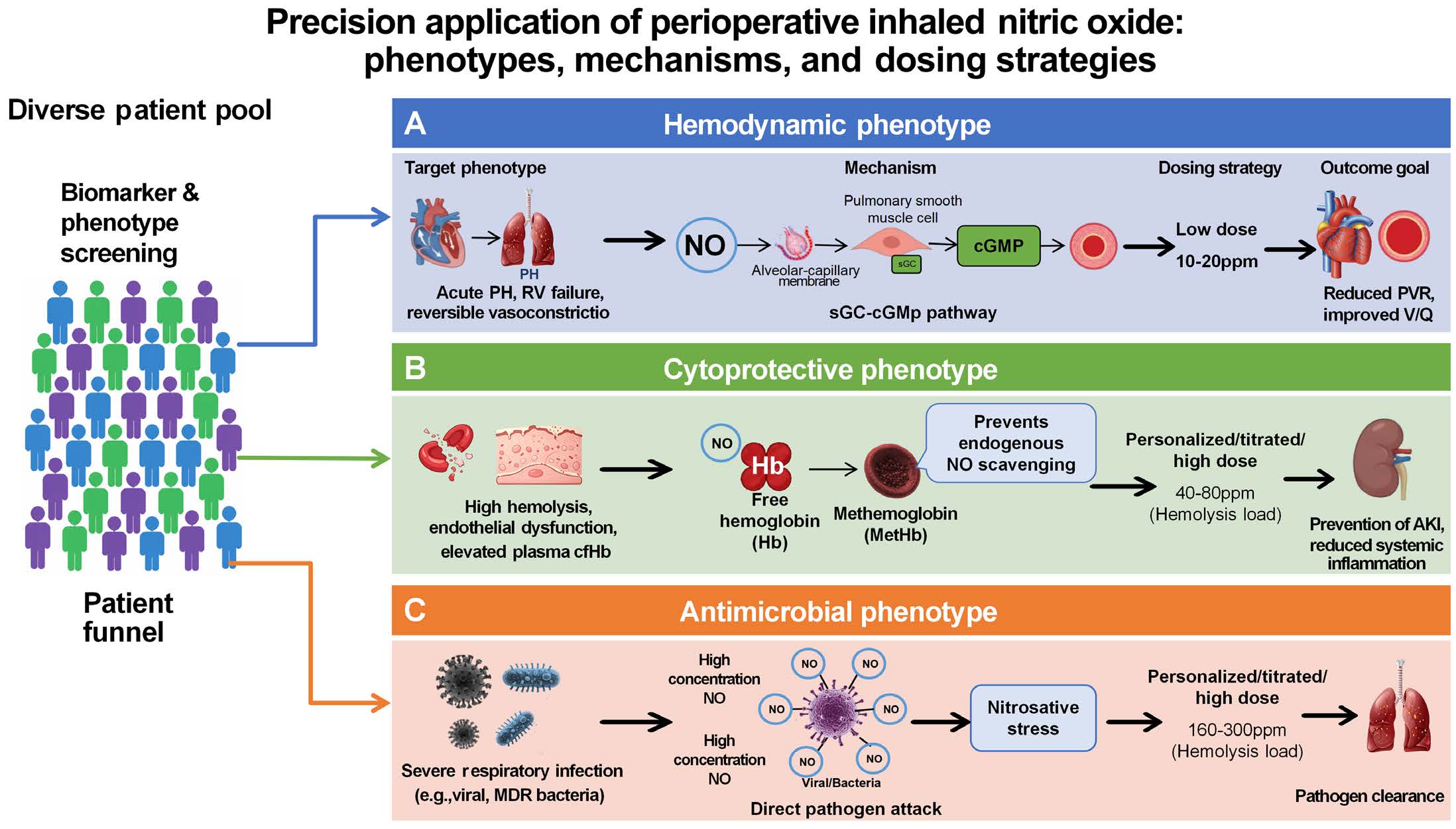
4.1 Targeting: The heterogeneity of treatment effect (HTE)
The effect of iNO reported in RCTs was mixed and sometimes contradictory. A good example is the use of iNO in reducing postoperative AKI following cardiac surgery. While early evidence suggested that exogenous NO supplementation could mitigate AKI, subsequent trials have yielded mixed or neutral results at the different sub-population level [2, 3, 5, 9].
RCTs remain the gold standard for estimating population-level efficacy. Still, their reliance on average treatment effects (ATE) can obscure clinically relevant heterogeneity of treatment effect (HTE). Recent observations suggest that response to iNO may differ between black and white individuals, and also between individuals with different baseline fHb levels [10]. To me, the key point is that the response to iNO is not binary. The core clinical insight is that iNO responsiveness is not binary; a distinct NO-responder phenotype exists, defined by baseline endothelial dysfunction and high hemolysis burden.
Current mechanistic data also demonstrate protective effects of iNO on the brain and splanchnic organs during hypothermic circulatory arrest and antegrade cerebral perfusion. This finding supports targeted iNO use in aortic arch surgery [11]. Yet, available clinical trials often pool patients with diverse phenotypes into one analysis.
The responder. Patients with acute, reversible vasoconstriction (e.g., CPB-induced dysfunction, hypoxic PH) or high levels of hemolysis. These patients demonstrate robust hemodynamic and cytoprotective responses [12].
The non-responder. Patients with fixed vascular remodeling (e.g., chronic thromboembolic PH) lack the smooth muscle substrate to dilate. Including these patients in trials may dilute efficacy signals [12].
The adverse responder. Patients with Left Ventricular Diastolic Dysfunction (LVDD), pulmonary vasodilation can increase preload to a stiff left ventricle, resulting in flash pulmonary edema.
4.2 Timing: Prophylactic vs. rescue
Timing shapes mechanism. Prophylactic iNO starts before or during CPB is required for renal protection because it neutralizes the generated fHb. Rescue therapy that starts after overt RV failure has developed may be too late to reverse established ischemic damage [13].
During CPB, hemolysis releases fHb, which acts as a massive scavenger of nitric oxide. In patients with severe hemolysis or pre-existing endothelial dysfunction (indicated by high baseline fHb), a low-dose iNO may be completely consumed by plasma fHb before it can produce any meaningful cytoprotective effect on the renal microvasculature [2]. Therefore, the dose has to match the scavenging intensity. This point is easily overlooked but critically important.
4.3 Titration: The dose-response
A meta-analysis suggests that efficacy is dose-dependent [13]. In patients with the hemodynamic phenotype, such as pulmonary hypertension or RV failure, who need local pulmonary vasodilation, a dose of 10–20 ppm is sufficient to lower PVR without systemic spillover [6, 13]. For patients requiring vasodilation, the therapeutic plateau occurs immediately at 10–20 ppm [14].
The situation differs for patients with cytoprotective phenotype, such as those with prolonged CPB or valve surgery with a marked hemolysis/endothelial dysfunction. These patients require high-dose iNO (40–80 ppm) to saturate the plasma fHb and restore systemic NO bioavailability. Preliminary investigations on super-high doses of iNO (160–300 ppm) have also demonstrated potential antimicrobial effect, which suggests a completely different dosing paradigm and underlying mechanism [8, 15].
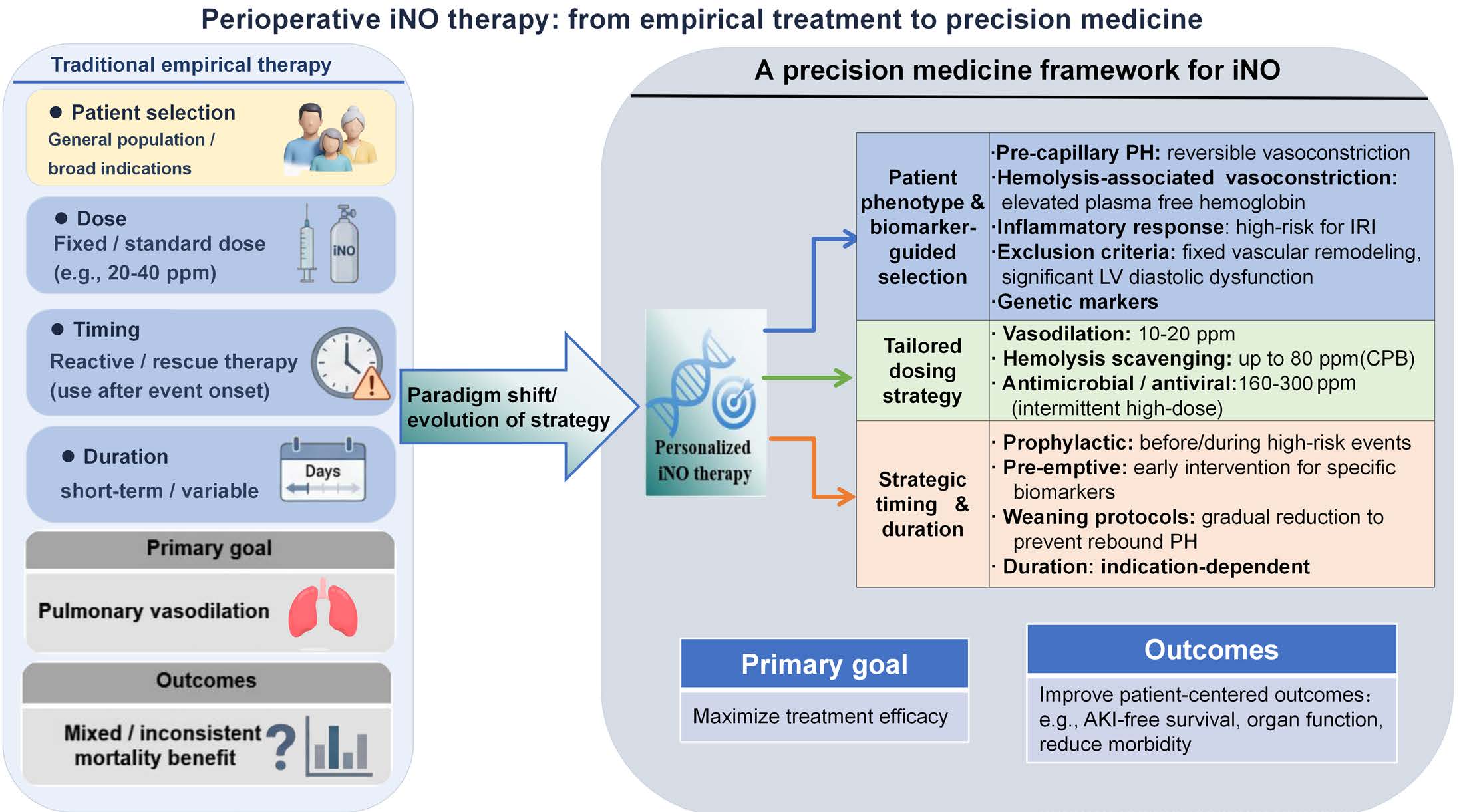
Future trials should move away from an all-comers design. Instead, enrollment should be enriched: (1) using biomarkers such as the fHb that reflect the level of hemolysis. For instance, to select patients with elevated plasma free hemoglobin for renal protection trials. Clinically applicable threshold values can be used for preliminary patient screening, a plasma free hemoglobin concentration exceeding 150 mg/L signifies robust NO-scavenging activity and disrupted endogenous NO homeostasis, identifying the primary cohort with deranged NO signaling. Complementary auxiliary biomarkers—including baseline plasma methemoglobin, circulating endothelial injury markers (soluble thrombomodulin, VCAM-1), and serum creatinine—may be combined to stratify patients presenting concurrent endothelial dysfunction and hemolysis-mediated NO depletion. (2) genotyping for the NOS3 or GUCY1A3 polymorphisms to identify genetic super-responders. (3) differentiating hemodynamic profiling, such as excluding patients with post-capillary PH (elevated PCWP), to avoid confounding harm signals.
Equally important, when applying iNO, the dosing or concentration (ppm) is not the only consideration. An administered concentration does not guarantee a predictable biological dose. When extrapulmonary or systemic effects are the goal, the more relevant variable is the amount of NO that is actually absorbed and that indeed interacts with circulating targets, not just the delivered concentration. Future strategies should therefore incorporate monitoring or modeling of NO uptake. This should account for lung volume, diffusion capacity, hemoglobin availability, and disease-specific changes, so that we can define a true delivered dose, especially in the target sites.
We further specify feasible bedside and laboratory operational approaches to quantify absorbed NO. First, real-time exhaled NO monitoring can calculate the net NO absorption by subtracting exhaled NO concentration from inspired iNO concentration, combined with minute ventilation to acquire total absorbed NO mass per hour. Second, serial plasma methemoglobin testing serves as an indirect surrogate marker: the molar conversion rate of ferrous hemoglobin to methemoglobin directly reflects the total NO absorbed and consumed by circulating hemoglobin. Third, multi-compartment physiological modeling integrating lung diffusion capacity, cardiac output, and total hemoglobin mass can predict tissue-level NO exposure at target organs (renal medulla, intestinal microcirculation). All three approaches can be combined to stratify patients requiring high-dose iNO to counteract excessive NO scavenging.
Personalized iNO dosing should match the intended mechanism of action. While 20 ppm may be sufficient for selective pulmonary vasodilation, 80 ppm may be optimal for hemolysis modulation during cardiopulmonary bypass. Much higher concentrations, even as high as 300 ppm or more, may be required for antimicrobial effects. Finally, rigorous physiology-based weaning protocols are essential to prevent rebound pulmonary hypertension caused by suppression of endogenous eNOS activity.
Inhaled nitric oxide is not a universal solution, but it is not a failed intervention either. Its inconsistent clinical record reflects the way it is applied across different clinical settings, more than it reflects absence of biological effect. In perioperative medicine, iNO engages in multiple physiological processes, such as pulmonary vasoregulation, hemolysis-associated endothelial dysfunction, IRI, and antimicrobial signaling. Each of these requires distinct timing and dosing strategies.
Therefore, the future focus is not broader use. It is smart and deliberate use. We need to identify patients in whom NO biology is actually disrupted, understand how much NO is actually absorbed rather than simply delivered, and align treatment with the mechanism we intend to influence. If we can approach iNO in this way, it becomes less of a reflex rescue gas and more of a pharmacologic therapy whose value depends on how precisely it is matches the underlying pathology.
Author contributions
CL and LB conceived the manuscript. CL, NOK, ZZ, and LW performed the literature review and drafted the manuscript. CL and LB critically revised the manuscript for intellectual content. All authors read and approved the final version of the manuscript.
Funding
This study was supported by the Hospital-funded Clinical Research Project (XJZT24LZ04) and the Hospital Medical Staff Technical Improvement Program for Diagnosis and Treatment (2025XJSM16) to C.L. The funders had no role in the design, writing, or decision to publish this manuscript.
Data availability
Not applicable. This manuscript does not contain original research data. All referenced data are available from the cited publications.
Ethics approval and consent to participate
Not applicable. This manuscript does not involve new studies with human participants or animals performed by any of the authors.
Consent for publication
Not applicable. This manuscript does not contain any individual person’s data in any form.
Competing interests
The authors declare that they have no competing interests.
Acknowledgements
The authors thank Dr. Binglan Yu (Massachusetts General Hospital, Harvard Medical School) for her insightful discussions on the mechanistic aspects of inhaled nitric oxide.
[5] Kamenshchikov NO, Tyo MA, Berra L, Kravchenko IV, Kozlov BN, Gusakova AM, et al. Perioperative nitric oxide conditioning reduces acute kidney injury in cardiac surgery patients with chronic kidney disease (the DEFENDER trial): A randomized controlled trial. Anesthesiology. 2025 Aug 1;143(2):287-299. https://doi.org/10.1097/aln.0000000000005494
[6] Kamenshchikov NO, Berra L, Carroll RW. Therapeutic effects of inhaled nitric oxide therapy in COVID-19 patients. Biomedicines. 2022 Feb 3;10(2):369. https://doi.org/10.3390/biomedicines10020369
[7] Chinese Society of Anesthesiology of Chinese Medical Association; Critical Care Branch of Beijing Perioperative Medicine Study Society; Critical Care Medicine Branch of Beijing Medical Association; National Alliance of Geriatric Anesthesiology. Expert consensus on the clinical application of inhaled nitric oxide in the perioperative period of adult surgical procedures (2026 edition). Natl Med J China. 2026 Feb 10;106(6):523-536. https://doi.org/10.3760/cma.j.cn112137-20251006-02569
[8] Valsecchi C, Winterton D, Safaee Fakhr B, Collier AY, Nozari A, Ortoleva J, et al. High-dose inhaled nitric oxide for the treatment of spontaneously breathing pregnant patients with severe coronavirus disease 2019 (COVID-19) pneumonia. Obstet Gynecol. 2022 Aug 1;140(2):195-203. https://doi.org/10.1097/aog.0000000000004847[12] Savale L, d'Humieres T, Boucly A, Habibi A, Lionnet F, Loko G, et al. Cardiopulmonary hemodynamic determinants of long-term survival in sickle cell disease: Insights from the ETENDARD study. Am J Respir Crit Care Med. 2025 Nov;211(11):2096-2104. https://doi.org/10.1164/rccm.202502-0353OC
[13] Yan Y, Kamenshchikov N, Zheng Z, Lei C. Inhaled nitric oxide and postoperative outcomes in cardiac surgery with cardiopulmonary bypass: A systematic review and meta-analysis. Nitric Oxide. 2024 May 1;146:64-74. https://doi.org/10.1016/j.niox.2024.03.004
[14] Griffiths MJ, Evans TW. Inhaled nitric oxide therapy in adults. N Engl J Med. 2005 Dec 22;353(25):2683-2695. https://doi.org/10.1056/NEJMra051884ISSN: 2957-5443
Volume 4, Issue 3
September 2026
Pages: 278-374


 Log In

 On This Page
 CITE
CITE