 Log In
Search




 Open Access
 18832379095@163.comOpen Access18832379095@163.com
Given that patients with hepatobiliary tumors are often complicated by liver cirrhosis and chemotherapy-induced liver damage, and their liver function reserve varies significantly, the risk of perioperative liver injury and complications remains very high. Clinicians usually use Child-Pugh score combined with laboratory parameters, including albumin, bilirubin, and coagulation function, to assess liver function, but an increasing number of studies show that these methods are insufficient [1]. Liver function reserve is a key factor affecting a patient’s surgical tolerance, incidence of ischemia-reperfusion injury and anesthetic drug metabolism capacity. This article focuses on constructing a perioperative individualized anesthesia management system with liver function reserve as its core. The preoperative aspect includes risk stratification through liver function scoring, multidisciplinary collaboration and imaging technology. The intraoperative stage optimizes anesthetic drug selection, maintains hemodynamic stability, precisely regulates anesthesia depth and protects liver perfusion. The postoperative stage dynamically monitors liver function, controls metabolic load and conducts prognostic follow-up. This system runs through the entire perioperative period, thereby effectively reducing the incidence of perioperative liver injury, which provides a standardized and individualized reference for the clinical practice of perioperative liver function protection in patients with hepatobiliary tumors.
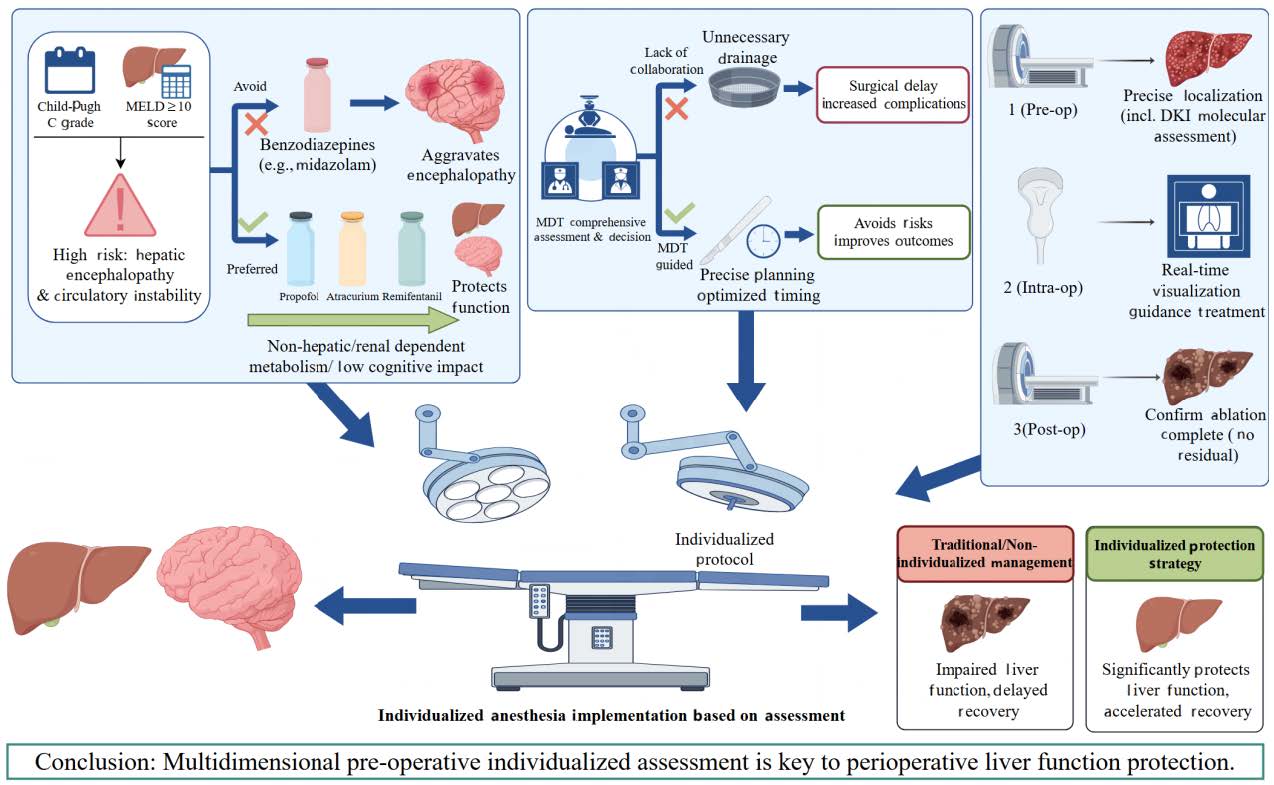
Patients with hepatobiliary tumors often have underlying diseases, including liver cirrhosis and portal hypertension, which pose huge challenges to intraoperative anesthesia management, while reasonable preoperative anesthesia assessment is established on the basis of liver function evaluation [2]. Contemporary preoperative liver function assessment relies on advanced imaging technologies, including computed tomography, magnetic resonance imaging (MRI), magnetic resonance elastography, and technetium-99m-labeled galactosyl human serum albumin, which can evaluate liver volume, perfusion and fibrosis, thereby improving the prediction accuracy of postoperative liver failure. The HOPE4LIVER trial confirmed that preoperative imaging assessment, intraoperative ultrasound guidance and early postoperative computed tomography or MRI evaluation are effective means to determine treatment response [3]. Diffusion kurtosis imaging can measure microstructural differences in tumors and can also detect severe types of liver cancer at an early stage, and these technologies can facilitate the implementation of liver protection protocols and optimize patient treatment outcomes [4]. However, a single modality has limitations, and relying solely on the above-mentioned technologies is insufficient to establish a comprehensive individualized anesthesia management system, therefore, preoperative stratification based on liver function reserve and perioperative surgical risk is crucial for hepatobiliary tumor surgery. Perioperative liver protection should be based on comprehensive preanesthesia assessment, thereby guiding the formulation of individualized intraoperative anesthesia management strategies through reasonable risk stratification.
Comprehensive preoperative assessment must include Child-Pugh classification, Model for End-Stage Liver Disease (MELD) score and other biochemical indicators of liver function, focusing on evaluating portal hypertension, ascites, and hepatic encephalopathy complications. If necessary, imaging examinations should be used to assess liver blood flow and liver tolerance to injury, which, combined with the Child-Pugh score, helps accurate risk stratification and also helps formulate an individualized anesthesia plan. A multidisciplinary team composed of hepatobiliary surgeons, hepatologists, and intensive care physicians helps complete preoperative risk grouping and individual anesthesia planning, while traditional benzodiazepines (e.g., midazolam) are usually avoided in clinical practice, with priority being given to drugs such as propofol, atracurium, and remifentanil, as these drugs do not aggravate hepatic encephalopathy and may improve relevant postoperative scores [5]. Patients with MELD score ≥10 have a higher incidence of intraoperative hypotension, which poses additional requirements for anesthesia management, and selecting appropriate anesthesia induction drugs and effective blood pressure management are crucial for these patients [6]. Standard preoperative assessment and individualized anesthesia plan are crucial for liver function protection during hepatobiliary tumor surgery. Figure 1 shows an integrated model of individualized preoperative anesthesia assessment and perioperative liver protection.

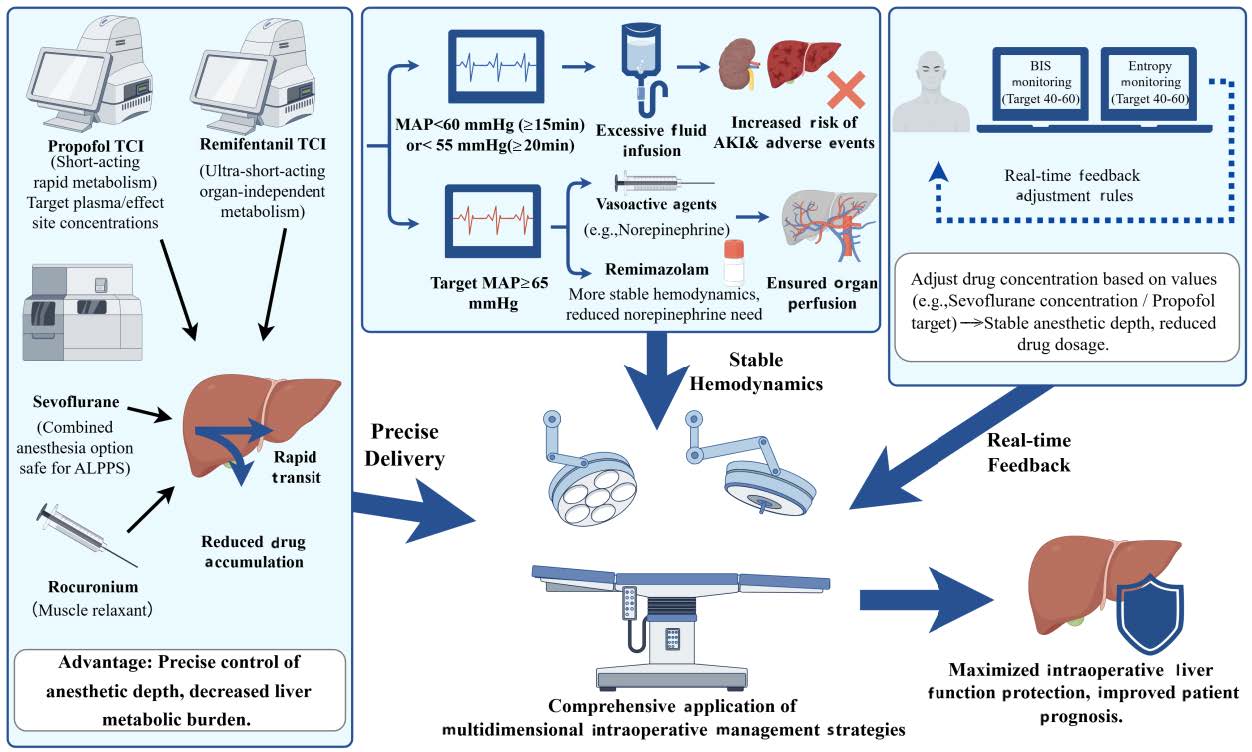
Patients with hepatobiliary tumors often have impaired liver function, which leads to decreased ability of the liver to metabolize drugs, and therefore, clinical selection should prioritize short-acting, easily titratable, and low hepatotoxicity intravenous anesthetic drugs. Propofol combined with remifentanil target-controlled infusion (TCI) is a commonly used clinical regimen. Propofol is metabolized rapidly and has significant extrahepatic metabolic pathways, while remifentanil metabolism is independent of liver and kidney function, which can minimize drug accumulation to the maximum extent, thereby maintaining stability of intraoperative anesthesia and protecting liver function, with partial hepatectomy being a complex surgical procedure, as complex procedures such as associating liver partition and portal vein ligation for staged hepatectomy (ALPPS) are often involved. In such surgeries, between combined intravenous-inhalational anesthesia (propofol TCI plus sevoflurane) and total intravenous anesthesia, no statistically significant differences were observed in postoperative liver function indicators including total bilirubin, alanine aminotransferase, and aspartate aminotransferase. This finding indicates that the combined anesthesia regimen does not cause additional burden on liver recovery and has a good safety profile [7]. Figure 2 shows combined application of precise anesthesia and liver protection during surgery.
In the early period after liver resection, hepatic blood flow and the systemic stress state of patients with hepatobiliary tumors undergo significant changes, which can easily lead to abnormal liver perfusion, hypoxia, and more severe ischemia-reperfusion injury. In addition, postoperative decline in liver function reserve and metabolic clearance capacity significantly increases the burden of liver detoxification, protein synthesis, and metabolism, thereby making the early postoperative period a high-risk stage for liver dysfunction, therefore, it is necessary to strengthen postoperative liver function monitoring, control the metabolic burden of the liver, and conduct post-anesthesia follow-up throughout the entire recovery process, which has important clinical significance for protecting postoperative liver function. These measures further support complete recovery of the liver, early identification of complications, and good long-term tumor prognosis.
A total bilirubin level >50 μmol/L (2.9 mg/dL) within 72 hours after liver surgery, together with a lactate level >3.0 mmol/L at 24 hours postoperatively, indicates insufficient recovery of liver function and high risk of liver failure [9]. A strategy of using early predictive biomarkers and risk stratification management can guide monitoring, optimize fluid therapy and hemodynamic support, and improve postoperative outcomes [10]. Lactate is a key biomarker for assessing liver function reserve and predicting adverse postoperative outcomes, with an elevated lactate level indicating microcirculatory dysfunction, while perioperative dynamic lactate monitoring and calculation of the ratio of postoperative to preoperative arterial lactate have higher accuracy in predicting postoperative complications, which is less affected by confounding variables [11]. Delayed lactate clearance, especially when combined with coagulation dysfunction and hyperbilirubinemia, requires early optimization of volume status, perfusion level, and supportive therapy to promote liver function recovery and reduce the incidence of complications. Continuous monitoring of liver function, coagulation status, lactate clearance, metabolic and nutritional parameters can achieve dynamic risk stratification, thereby guiding optimization of analgesia, fluid therapy and nutritional support to ensure adequate liver perfusion and metabolic homeostasis. Serial measurements of serum biomarkers can longitudinally assess liver function recovery and support monitoring of minimal residual disease and tumor recurrence. A decline or normalization of alpha-fetoprotein levels is associated with good prognosis, while persistently elevated levels indicate ongoing tumor activity, and incorporation of these biomarkers into follow-up protocols can accurately predict recurrence risk and guide individualized treatment interventions, thereby improving long-term survival outcomes [12].
Patients with hepatobiliary tumors often have underlying liver disease, including cirrhosis. The core of perioperative anesthesia management is an individualized liver protection strategy, in which accurate preoperative assessment, reasonable intraoperative regulation, and dynamic postoperative monitoring are key elements. Combining MRI with technetium-99m-labeled galactosyl human serum albumin scintigraphy, and imaging modalities with Child-Pugh classification, MELD score, and multidisciplinary team collaboration enables accurate risk stratification, thereby establishing a solid foundation for individualized treatment plans. During surgery, clinicians should primarily use short-acting anesthetic drugs with low hepatotoxicity, and propofol combined with remifentanil TCI is the preferred method. Compared with large-volume fluid resuscitation, this regimen preferentially uses norepinephrine to maintain stable blood pressure, which, when combined with goal-directed fluid therapy, can effectively protect liver perfusion. Postoperatively, examining lactate levels, coagulation parameters, and liver function tests helps in the early detection of liver injury, thus guiding subsequent management. Future efforts should focus on the combined application of imaging technologies and biomarkers, optimization of clinical protocols for new anesthetic drugs, and construction of a more precise individualized liver protection system, thereby further reducing the risk of perioperative liver injury and improving long term prognosis of patients.
Author contributions
Ruilin Li and Tong Chu contributed to the manuscript writing and figure preparation; Tongyao Li and Xingtong Ren designed the work; Tongyao Li supervised the work. All authors read and approved the final manuscript.
Funding
This research received no external funding.
Data availability
Data sharing not applicable to this article as no datasets were generated or analyzed during the current study. All information is derived from publicly available articles and datasets.
Ethics approval and consent to participate
Not applicable. This manuscript does not contain any studies with human participants or animals performed by any of the authors.
Consent for publication
Not applicable. This manuscript does not include details, images, or videos relating to an individual person.
Competing interests
The authors declare that they have no competing interests.
Acknowledgements
Not applicable.
[1] Huang J, Long H, Peng J, Zhong X, Shi Y, Xie X, et al. Predicting post-hepatectomy liver failure preoperatively for child-pugh a5 hepatocellular carcinoma patients by liver stiffness. J Gastrointest Surg. 2023 Jun;27(6):1177-1187. https://doi.org/10.1007/s11605-023-05635-7
[2] Watanabe Y, Aikawa M, Murase Y, Takase K, Watanabe Y, Ono H, et al. Stage-specific impact of portal hypertension on outcomes after liver resection in hepatocellular carcinoma. Hepatol Int. 2025 Dec;19(6):1454-1467. https://doi.org/10.1007/s12072-025-10879-3
[3] Mendiratta-Lala M, Wiggermann P, Pech M, Serres-Créixams X, White SB, Davis C, et al. The #HOPE4LIVER single-arm pivotal trial for histotripsy of primary and metastatic liver tumors. Radiology. 2024 Sep;312(3):e233051. https://doi.org/10.1148/radiol.233051
[4] Chen J, Liu D, Guo Y, Zhang Y, Guo Y, Jiang M, et al. Preoperative identification of cytokeratin 19 status of hepatocellular carcinoma based on diffusion kurtosis imaging. Abdom Radiol (NY). 2023 Feb;48(2):579-589. https://doi.org/10.1007/s00261-022-03736-6
[5] Chen T, Wen L, Zhong R, Chen X. General anesthesia in patients with hepatic encephalopathy and acute variceal bleeding undergoing endoscopic treatment: A retrospective study. Medicine (Baltimore). 2023 Aug 25;102(34):e34395. https://doi.org/10.1097/md.0000000000034395
[6] Paternostro R, Kwanten WJ, Hofer BS, Semmler G, Bagdadi A, Luzko I, et al. Hepatic venous pressure gradient predicts risk of hepatic decompensation and liver-related mortality in patients with MASLD. J Hepatol. 2024 Nov;81(5):827-836. https://doi.org/10.1016/j.jhep.2024.05.033
[7] Xu F, Jiang H, Jin M, Peng Q. Application of propofol combined with sevoflurane anesthesia in staged hepatectomy liver detachment and portal vein ligation. Exp Ther Med. 2021 Sep;22(3):921. https://doi.org/10.3892/etm.2021.10353
[8] Kan CFK, Skaggs JD. Current commonly used dynamic parameters and monitoring systems for perioperative goal-directed fluid therapy: A review. Yale J Biol Med. 2023 Mar;96(1):107-123. https://doi.org/10.59249/joap6662
[9] Niederwieser T, Braunwarth E, Dasari BVM, Pufal K, Szatmary P, Hackl H, et al. Early postoperative arterial lactate concentrations to stratify risk of post-hepatectomy liver failure. Br J Surg. 2021 Nov 11;108(11):1360-1370. https://doi.org/10.1093/bjs/znab338
[10] Abdelhadi S, El-Ahmar M, Vedder K, Halawa M, Orth V, Hermann M, et al. Early postoperative liver function parameters as predictors of post-hepatectomy liver failure. Front Surg. 2025 Oct 21;12:1669938. https://doi.org/10.3389/fsurg.2025.1669938
[11] Wang D, Dong M, Xie Y, Xu F, Fu T, Wu Y, et al. Effect of early peri-operative arterial lactate concentration level ratios on post-hepatectomy liver failure. Discov Oncol. 2024 Mar 21;15(1):81. https://doi.org/10.1007/s12672-024-00911-7
[12] Wang M, Qian G, Xiao H, Liu X, Sun L, Chen Z, et al. Prognostic significance of postoperative serological incomplete conversion of AFP and PIVKA-II after hepatic resection for hepatocellular carcinoma: A multicenter analysis of 1755 patients. Oncologist. 2024 Dec 6;29(12):e1723-e1733. https://doi.org/10.1093/oncolo/oyae139
ISSN: 2957-5443
Volume 4, Issue 3
September 2026
Pages: 278-374


 Log In

 On This Page
 CITE
CITE