 Log In
Search




 Open Access
 30994470@qq.comOpen Access30994470@qq.com
The increasing incidence of severe infections is one of the most formidable challenges for critical care medicine, and it is increasingly common worldwide. The epidemiology shows that millions are admitted annually for sepsis and related morbidities, with age-dependent surges in the incidence of sepsis, and a higher risk among elderly patients or those with comorbid conditions [1]. Severe infections have highly variable clinical follow-up needs. Continuous development of antibiotics and intensive care units, along with early diagnosis and combined targeted treatments, still plays a key role in reducing patient mortality.
Severe infection progresses rapidly and is hard to identify, so early recognition is critical to lowering mortality. Conventional inflammatory markers are slow to respond although they are relatively sensitive to stress. Blood cultures (BC) are sensitive, and BC identification detects 50–80% of mixed infections [2, 3]. However, data from large cohorts indicate that only half of cases are accurately diagnosed, since BC often fails to identify low-virulence organisms [2]. Thus, the simultaneous detection of multi-biomarkers has attracted wide research attention to get a balance between sensitivity and specificity for optimal diagnosis and risk stratification.
This diagnostic challenge is particularly evident in vulnerable populations, such as neonates and preterm infants, in whom severe infections may progress rapidly and lead to high mortality in the neonatal intensive care unit. From a clinical perspective, early diagnosis is crucial with the requirement of simultaneous identification of platelet count and platelet indices to optimize comorbid status [4]. Combined detection of multiple biomarkers is an important means to promote early identification of infection; however, clinical application issues remain unsolved, such as lack of standardization, and the approach is risk-dependent.
2.1 Classification of common biomarkers
Biomarkers of severe infection may be classified based on their origin and functions. Systemic inflammatory response is characterized by so-called pro-inflammatory cytokines, such as C-reactive protein (CRP), procalcitonin (PCT), and interleukin (IL)-6. IL-2 and IL-6 also contribute to improved diagnosis of bacterial infection in laboratory testing. Immune-related biomarkers, such as IL-10 and tumor necrosis factor-α (TNF-α), reflect host immune shifts in sepsis; elevated IL-10 indicates immunosuppression and poor prognosis, whereas increased TNF-α suggests hyperinflammation and worse outcomes [5, 6]. Infection-related organ injury is assessed with lactate and liver/kidney function tests. All of these biomarkers can be affected by confounding factors, so the diagnostic and prognostic effects are complementary, warranting their combined use in clinical practice.
2.2 Roles of various biomarkers in diagnosis
Various infection biomarkers serve distinct diagnostic roles. Pathogen-related markers (such as PCT) identify bacterial infections and assess severity; inflammatory or immune-related markers indicate inflammatory and immune status; organ function-related markers evaluate disease progression and prognosis. Combining markers may enhance sensitivity and support early diagnosis. However, biomarker results should be interpreted alongside clinical conditions and individual characteristics to avoid overreliance on a single marker and ensure accurate diagnosis and treatment.
2.3 Research progress on emerging biomarkers
Emerging multi-omics technologies have revealed new biomarkers for severe infections, including immune checkpoint molecules, extracellular vesicle miRNAs, metabolomics, and host transcriptomics. One candidate marker is histone H3 lysine 18 lactylation, which reflects disease severity and regulates macrophage anti-inflammatory function during sepsis through arginase-1 expression and inflammatory factors [7]. For example, extracellular vesicle-derived miRNA signatures have shown high diagnostic accuracy for septic shock, with a three-miRNA model (miR-100-5p, miR-148a-3p, and miR-451a) achieving an area under the curve of 0.894 in validation cohorts [8]. These functional biomarkers reveal immune dysregulation characterized by concurrent inflammation enhancement and immune evasion, paving the way for early risk stratification, prognostic assessment, and personalized therapy. However, there is a lack of standardization, accompanied by high cost and limited accessibility.
3.1 Improved sensitivity and specificity
Systemic combined detection of severe infection markers improves diagnostic sensitivity and specificity. Individually, single biomarkers fail to detect early infections due to biological variation and comorbidities. However, multi-biomarker evaluation offsets these limitations through complementary effects. For example, combined detection of IL-6 and PCT showed a sensitivity of 93.84% and a specificity of 96.72% for severe bacterial infection [9]. Thus, combined detection supports early diagnosis and individualized clinical decision-making.
3.2 Promoting the practice of individualized medicine
Multiplex detection of severe infection biomarkers reflects the inflammatory and immune status to guide individualized medicine. IL-1β, IL-6, and TNF-α are significantly elevated in sepsis-induced cardiomyopathy, and their combined detection improves diagnostic and prognostic evaluation [10]. These inflammatory factors and related parameters could be incorporated to dynamically assess infection severity and progression, thereby guiding antimicrobial therapy, identifying high-risk patients, and tailoring interventions, serving as a quantitative prognostic reference.
3.3 Improving clinical decision-making and patient prognosis
Multiplex detection improves the early diagnosis of deep infections, aiding risk stratification and therapy. Tracking IL-6, PCT, and CRP identifies high-risk patients for timely treatment and monitoring adjustments. No single biomarker is diagnostic by itself and must align with clinical data. Simultaneous detection enhances diagnostic accuracy and enables individualized management of severe infections, as shown in Figure 1.

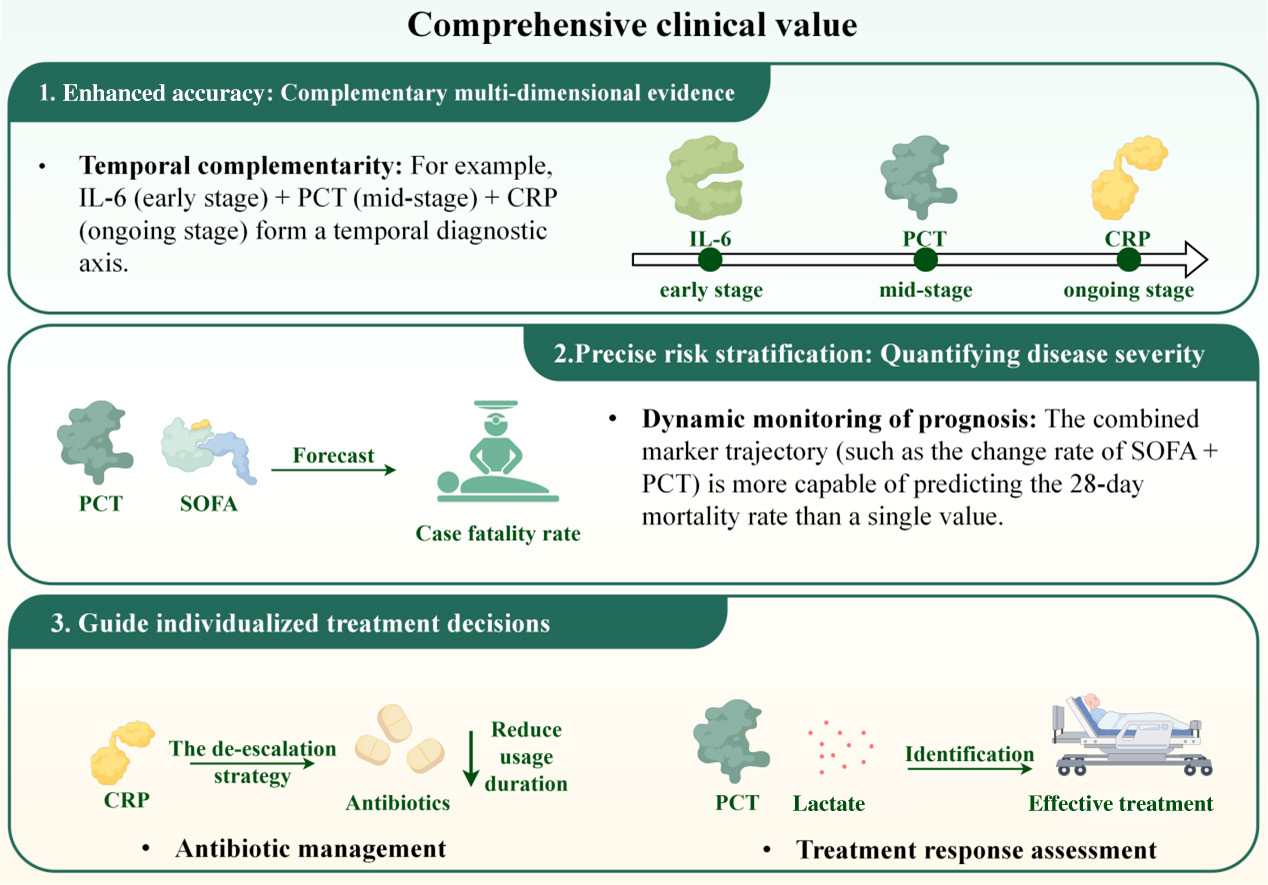
Figure 1. Schematic of the comprehensive clinical value of combined biomarker detection in diagnosis and risk stratification of severe infections. This figure visually depicts the integrated clinical value provided by the simultaneous detection of multiple biomarkers (e.g., IL-6, PCT, CRP, lactate, and the SOFA score) for the diagnosis, risk stratification, and individualized treatment guidance of patients with severe infections. The model illustrates the synergistic nature of biomarkers applied over a continuum and at specific monitoring time points for prognostic value and utility to guide antibiotic de-escalation therapy and assess its efficacy. IL-6, interleukin-6; PCT, procalcitonin; CRP, C-reactive protein; SOFA, Sequential Organ Failure Assessment.
4.1 Potential risks of misdiagnosis and missed diagnosis
These biomarkers indicate immune dysregulation involving both inflammatory amplification and suppression, supporting early stratification, prognostic assessment, and individualized therapy. However, lack of standardization, high cost, limited availability and insufficient validation restrict clinical use. Pro- and anti-inflammatory cytokines in hypothermic sepsis are generally low, and combined detection may fail to detect these cytokines, increasing false negatives [11]. Ignoring history, signs and imaging leads to misdiagnosis and mistreatment. Thus, combination assays must be applied within the clinical context and interpreted cautiously.
4.2 Increased healthcare costs and resource waste
Multiplex biomarker detection may improve the diagnostic sensitivity for severe infections, but at a high cost. Repeated testing increases expenses, prolongs hospitalization and treatment, and consumes resources. Without specific indications, no evidence shows combined detection improves outcomes; instead, it burdens laboratories and adds cost. Hence, evaluating the economic value and clinical necessity of multiplex biomarker testing is necessary for rational and sustainable clinical management.
4.3 Risk of deviating from clinical judgment
Simultaneous evaluation of PCT, CRP, and IL-6 may improve diagnostic and prognostic assessment in severe infection and support clinical decision-making before pathogen identification [12]. As shown in Figure 2, IL-6 increases earlier than PCT, a bacterial infection marker. PCT and lactate require serial monitoring with the Sequential Organ Failure Assessment score to predict shock risk. However, biomarker levels vary with age and comorbidities, and overreliance may obscure accurate assessment and cause overtreatment. Thus, biomarker detection should be integrated with symptoms, signs, and imaging to guide individualized management.
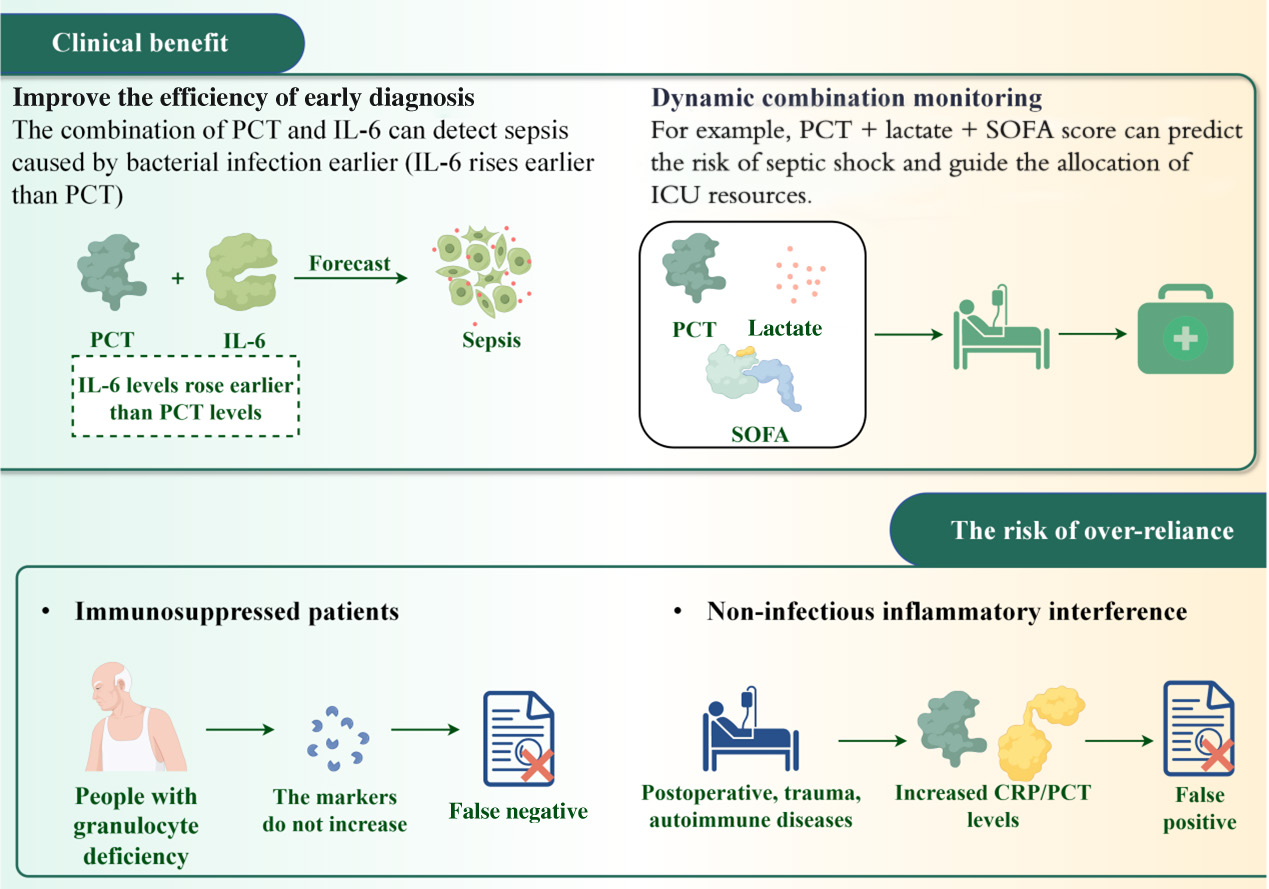
Figure 2. Clinical value and potential risks of combined biomarker detection in severe infections. This figure illustrates the clinical significance of multi-biomarker multi-signals (PCT, IL-6, lactate, SOFA) detection-based prediction in severe infections such as improving early diagnosis and dynamic monitoring and evaluating prognosis. It also highlights the potential for false negative or false positive test results in particular patient populations like immunosuppressed patients. PCT, procalcitonin; IL-6, interleukin-6; SOFA, Sequential Organ Failure Assessment; ICU, intensive care unit; CRP, C-reactive protein.
Advances in molecular diagnostics and high-throughput technologies enable precise multidimensional detection of severe infection biomarkers. Liquid biopsy, single-cell analysis, and multiplex immunoassays jointly assess multiple biomarkers, improving sensitivity and specificity. Artificial intelligence and machine learning (e.g., Light Gradient Boosting Machine, Extreme Gradient Boosting Machine, Random Forest) show strong predictive ability in sepsis-associated liver injury. Stacked ensembles enhance prediction robustness for early intervention and personalized therapy [13]. These research findings indicate that the future application of biomarkers should not be limited to the interpretation of a single biomarker, but rather should combine molecular indicators with clinical variables. Nonetheless, these emerging techniques are in need of multi-center validation and guideline development for clinical application in order to tackle issues concerning standardization, cost, and practicability.
Clinically, it is often difficult to distinguish infection-related complications solely based on traditional biomarkers. Therefore, comprehensive analysis is particularly important. Pneumonia, severe sepsis and septic shock are common complications in patients following an out-of-hospital cardiac arrest and are associated with high mortality. PCT and CRP provide limited diagnostic value for infectious complications, and hence lead to incorrect diagnoses derived from electronic medical records if used as the sole biomarkers [14]. Integrating clinical data with biomarker results leads to improved diagnoses and therapy. Biomarkers should be interpreted dynamically against the background of disease progression, comorbidities, infection risk, imaging, microbiology and vital signs to enable comprehensive decision-making. Unifying interpretations may help standardize use, reduce unnecessary interventions and facilitate early identification and targeted treatment of severe infections.
In addition to diagnosis and risk prediction, biomarker-guided strategies also have practical value in treatment monitoring and antimicrobial stewardship. Evidence-based protocols for combined biomarker assessment in severe infections should define each biomarker’s role in diagnosis, monitoring, and treatment evaluation. A PCT-based algorithm guiding antibiotic use in acute pancreatitis reduced unnecessary antimicrobial exposure without compromising safety [15]. Age, comorbidities, and immune status must be considered when setting thresholds and strategies. Overall, future efforts should not only expand biomarker detection but also establish a clinically validated, cost-effective, and dynamically interpretable detection strategy. Through multi-center research, standardized biomarker combinations, thresholds for different disease stages, and clinical decision-making algorithms should be developed. In particular, the detection results of biomarkers should be combined with patients’ clinical signs, imaging, microbiology, and electronic health data. Eventually, the combined detection of biomarkers can not only be used for the early diagnosis of infectious diseases, but also for risk stratification, treatment monitoring, and antibiotic management of severe infections.
Author contributions
Lizhou Song and Yunchao Zhou contributed to the manuscript writing and figure preparation; Jibo Zhao designed the work; Lu Yan and Puyong Mi supervised the work. All authors read and approved the final manuscript.
Funding
This research received no external funding.
Data availability
Data sharing not applicable to this article as no datasets were generated or analyzed during the current study. All information is derived from publicly available articles and datasets.
Ethics approval and consent to participate
Not applicable. This manuscript does not contain any studies involving human participants or animals conducted by any of the authors.
Consent for publication
Not applicable. This manuscript does not include details, images, or videos relating to any individual person.
Competing interests
The authors declare that they have no competing interests.
Acknowledgements
Not applicable.
[1] GBD 2021 Global Sepsis Collaborators. Global, regional, and national sepsis incidence and mortality, 1990-2021: A systematic analysis. Lancet Glob Health. 2025 Dec;13(12):e2013-e2026. https://doi.org/10.1016/S2214-109X(25)00356-0
[2] Bradford WS, Donnelley MA, Fine JR, Crabtree SJ. Blood culture identification (BCID) performance in polymicrobial bacteremia. Diagn Microbiol Infect Dis. 2023 Dec;107(4):116086. https://doi.org/10.1016/j.diagmicrobio.2023.116086
[3] Kim KJ, Yun SG, Cho Y, Lee CK, Nam MH. Rapid direct identification of microbial pathogens and antimicrobial resistance genes in positive blood cultures using a fully automated multiplex PCR assay. J Korean Med Sci. 2024 May 6;39(17):e157. https://doi.org/10.3346/jkms.2024.39.e157
[4] Patil NJ, Tuli S, Kanetkar SR, Mishra S, Saad K. Early diagnosis of neonatal sepsis using hematological profiles. J Pharm Bioallied Sci. 2024 Jul;16(Suppl 3):S2530-S2532. https://doi.org/10.4103/jpbs.jpbs_343_24
[5] Dagys A, Laucaityté G, Volkevičiūtė A, Abramavičius S, Kėvalas R, Vitkauskienė A, et al. Blood biomarkers in early bacterial infection and sepsis diagnostics in feverish young children. Int J Med Sci. 2022;19(4):753-761. https://doi.org/10.7150/ijms.69859
[6] Gharamti AA, Samara O, Monzon A, Montalbano G, Scherger S, DeSanto K, et al. Proinflammatory cytokines levels in sepsis and healthy volunteers, and tumor necrosis factor-alpha associated sepsis mortality: A systematic review and meta-analysis. Cytokine. 2022 Oct;158:156006. https://doi.org/10.1016/j.cyto.2022.156006
[7] Chu X, Di C, Chang P, Li L, Feng Z, Xiao S, et al. Lactylated histone H3K18 as a potential biomarker for the diagnosis and predicting the severity of septic shock. Front Immunol. 2021;12:786666. https://doi.org/10.3389/fimmu.2021.786666
[8] Garcia-Concejo A, Sanchez-Quiros B, Gomez-Sanchez E, Sanchez-de Prada L, Tamayo-Velasco A, Tovar-Doncel MS, et al. Study on the diagnostic role of exosome-derived miRNAs in postoperative septic shock and non-septic shock patients. Crit Care. 2025 Mar 3;29(1):96. https://doi.org/10.1186/s13054-025-05320-y
[9] Bian F, Wu Y, Zhang C. Variation in the levels of IL-6 in pediatric patients with severe bacterial infectious diseases and correlation analysis between the levels of IL-6 and procalcitonin. Exp Ther Med. 2017 Jun;13(6):3484-3488. https://doi.org/10.3892/etm.2017.4395
[10] Deng P, Tang N, Li L, Zou G, Xu Y, Liu Z. Diagnostic value of combined detection of IL-1β, IL-6, and TNF-α for sepsis-induced cardiomyopathy. Med Clin (Barc). 2022 May 13;158(9):413-417. https://doi.org/10.1016/j.medcli.2021.04.025
[11] Bhavani SV, Spicer A, Sinha P, Malik A, Lopez-Espina C, Schmalz L, et al. Distinct immune profiles and clinical outcomes in sepsis subphenotypes based on temperature trajectories. Intensive Care Med. 2024 Dec;50(12):2094-2104. https://doi.org/10.1007/s00134-024-07669-0
[12] Aktas F, Zer Y, Elay G, Erinmez M. First signs at admission: Prognostic value of initial proinflammatory markers for sepsis and mortality in ICU patients. Pathogens. 2025 Sep 10;14(9). https://doi.org/10.3390/pathogens14090907
[13] Lei J, Zhai J, Zhang Y, Qi J, Sun C. Supervised machine learning models for predicting sepsis-associated liver injury in patients with sepsis: Development and validation study based on a multicenter cohort study. J Med Internet Res. 2025 May 26;27:e66733. https://doi.org/10.2196/66733
[14] Dankiewicz J, Nielsen N, Linder A, Kuiper M, Wise MP, Cronberg T, et al. Infectious complications after out-of-hospital cardiac arrest-A comparison between two target temperatures. Resuscitation. 2017 Apr;113:70-76. https://doi.org/10.1016/j.resuscitation.2016.12.008
[15] Siriwardena AK, Jegatheeswaran S, Mason JM. A procalcitonin-based algorithm to guide antibiotic use in patients with acute pancreatitis (PROCAP): A single-centre, patient-blinded, randomised controlled trial. Lancet Gastroenterol Hepatol. 2022 Oct;7(10):913-921. https://doi.org/10.1016/s2468-1253(22)00212-6
ISSN: 2957-5443
Volume 4, Issue 2
June 2026
Pages: 149-277


 Log In

 On This Page
 CITE
CITE