
Endless possibilities in academia
Endless possibilities in academia
Ke Wang, Rongguo Yan, Wenjing Du, Shoucheng Chen
School of Health Science and Engineering, University of Shanghai for Science and Technology, Shanghai 200093, China.
Address correspondence to: Rongguo Yan, School of Health Science and Engineering, University of Shanghai for Science and Technology, No. 516, Jun Gong Road, Yangpu District, Shanghai 200093, China. E-mail: yanrongguo@usst.edu.cn.
DOI: https://doi.org/10.61189/931077ergknd
Received November 18, 2025; Accepted January 16, 2026; Published June 3, 2026
Highlights
● Established potential displacement-charge-voltage relation for polyvinylidene fluoride by means of the first-order piezoelectric equation.
● Applied COMSOL multilayer shell model and multiphysics coupling for calculating the interlayer stress and electric displacement field.
● Structurally explored how changes to structural parameters impacted sensor performance through the control variable method.
Research Article |Published on: 03 June 2026
[Progress in Medical Devices] 2026; 4 (2): 77-90
Rong Pang1, Chen He1, Huidong Wu2
1School of Health Science and Engineering, University of Shanghai for Science and Technology, Shanghai 200093, China.
2Department of Prosthetic and Orthotic Engineering, School of Rehabilitation, Kunming Medical University, Kunming 650032, Yunnan, China.
Address correspondence to: Chen He, School of Health Science and Engineering, University of Shanghai for Science and Technology, No. 516 Jungong Road, Yangpu District, Shanghai 200093, China. E-mail: hechen@usst.edu.cn.
DOI: https://doi.org/10.61189/126256lnkxbu
Received November 21, 2025; Accepted April 16, 2026; Published June 18, 2026
Highlights
● Electromyographic activity, muscle stiffness, and pain threshold on the convex side of the scoliotic curve exhibited significantly higher than those on the concave side.
● In adolescent idiopathic scoliosis patients, there was a weak correlation between electromyographic activity, muscle stiffness, and pain threshold of the paraspinal muscles.
Research Article |Published on: 18 June 2026
[Progress in Medical Devices] 2026; 4 (2): 91-97
Yuxiao Li, Junjie Shen, Yuxuan Hou, Shilong Li, Chengli Song, Lin Mao
Shanghai Institute for Minimally Invasive Therapy, School of Health Science and Engineering, University of Shanghai for Science and Technology, Shanghai 200093, China.
Address correspondence to: Lin Mao, Shanghai Institute for Minimally Invasive Therapy, School of Health Science and Engineering, University of Shanghai for Science and Technology, No. 516 Jungong Road, Yangpu District, Shanghai 200093, China. Tel: +86-21-55572159. E-mail: linmao@usst.edu.cn.
DOI: https://doi.org/10.61189/030332bzapdu
Received November 28, 2025; Accepted February 7, 2026; Published June 17, 2026
Highlights
● Current innovation in gastrointestinal defect management falls into two main categories: clip-based mechanical compression devices and advanced high-precision endoscopic suturing systems.
● Through-the-scope clips combined with auxiliary devices offer a strategic solution to overcome the size limitations inherent to single-device closure strategies for larger or complex defects.
● Future technological development should focus on enhancing reliability, operability, cost-effectiveness, and overall user-friendliness of advanced endoscopic closure devices to broaden their clinical applicability.
Review Article |Published on: 17 June 2026
[Progress in Medical Devices] 2026; 4 (2): 98-115
Jin Xu, Shiju Yan
School of Health Science and Engineering, University of Shanghai for Science and Technology, Shanghai 200093, China.
Address correspondence to: Shiju Yan, School of Health Science and Engineering, University of Shanghai for Science and Technology, No. 334 Jungong Road, Yangpu District, Shanghai 200093, China. E-mail: yanshj99@aliyun.com.
DOI: https://doi.org/10.61189/828857qvjtwr
Received December 3, 2025; Accepted April 30, 2026; Published June 18, 2026
Review Article |Published on: 18 June 2026
[Progress in Medical Devices] 2026; 4 (2): 116-123
Mingzhi Zhang, Piding Li
School of Health Science and Engineering, University of Shanghai for Science and Technology, Shanghai 200093, China.
Address correspondence to: Piding Li, School of Health Science and Engineering, University of Shanghai for Science and Technology, No. 516 Jungong Road, Yangpu District, Shanghai 200093, China. E-mail: lpdbyusst@163.com.
DOI: https://doi.org/10.61189/784716ypyhmm
Received November 28, 2025; Accepted February 27, 2026; Published June 24, 2026
Highlights
● We use two types of cardiac physiological signals together. They complement each other and help improve the final classification accuracy.
● This study converts phonocardiograms and electrocardiograms into time–frequency images, which helps increase the positive detection rate and enables automatic learning of modality-specific features through a neural network.
● This study modifies the baseline model to achieve a more streamlined neural network architecture and incorporates an attention mechanism to better focus on information correlations.
Research Article |Published on: 24 June 2026
[Progress in Medical Devices] 2026; 4 (2): 124-134
Junjie Shen, Zhongxin Hu, Chengli Song, Lin Mao
Shanghai Institute for Minimally Invasive Therapy, School of Health Science and Engineering, University of Shanghai for Science and Technology, Shanghai 200093, China.
Address correspondence to: Lin Mao, Shanghai Institute for Minimally Invasive Therapy, School of Health Science and Engineering, University of Shanghai for Science and Technology, No. 516 Jungong Road, Yangpu District, Shanghai 200093, China. Tel: +86-21-55572159. E-mail: linmao@usst.edu.cn.
DOI: https://doi.org/10.61189/748101ldqptn
Received January 24, 2026; Accepted March 25, 2026; Published June 24, 2026
Highlights
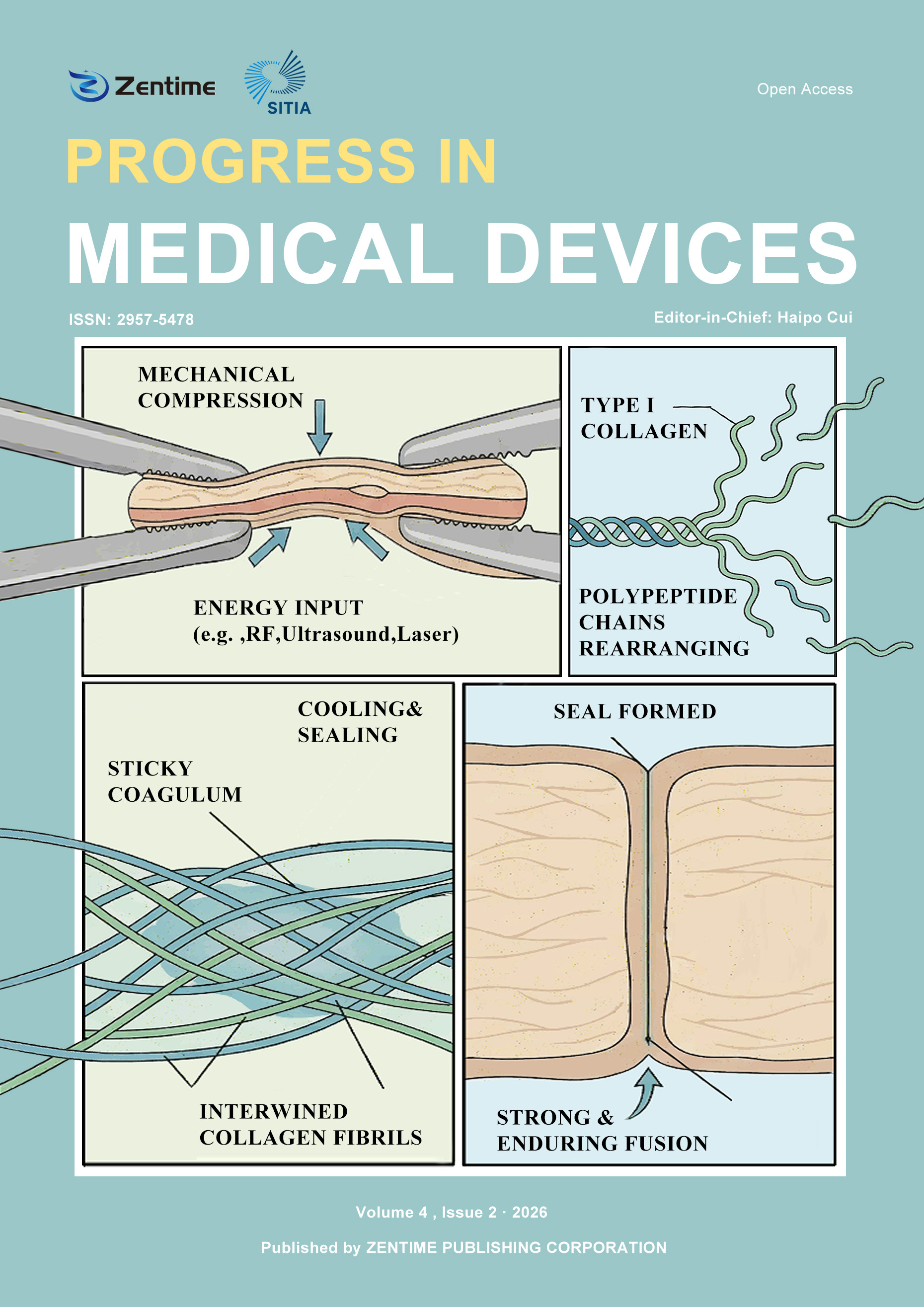
● Mechanistic comparison of radiofrequency, ultrasonic, and laser energy modalities for achieving collagen denaturation in tissue fusion.
● Critical evaluation of three leading device platforms (LigaSureTM, HarmonicTM, and ThunderbeatTM) across surgical specialties and performance metrics.
● Future integration of artificial intelligence and robotic systems to enhance precision and safety in energy-based surgical devices.
Review Article |Published on: 24 June 2026
[Progress in Medical Devices] 2026; 4 (2): 135-147
Yuming Liu, Piding Li
School of Health Science and Engineering, University of Shanghai for Science and Technology, Shanghai 200093, China.
Address correspondence to: Piding Li, School of Health Science and Engineering, University of Shanghai for Science and Technology, No. 516 Jungong Road, Yangpu District, Shanghai 200093, China. E-mail: lpdbyusst@163.com.
DOI: https://doi.org/10.61189/744920nwaoek
Received March 11, 2026; Accepted April 20, 2026; Published June 25, 2026
Highlights
● A multi-frequency electromagnetic excitation scheme is proposed for the detection and localization of tiny metallic foreign bodies inside the human body.
● By integrating SHE-PWM with a full-bridge Class-D power amplifier, the transmitter achieves energy-efficient, spectrally controllable, and synchronous multi-frequency excitation.
Research Article |Published on: 25 June 2026
[Progress in Medical Devices] 2026; 4 (2): 148-164
Peiyu Chen, Xudong Guo
School of Health Science and Engineering, University of Shanghai for Science and Technology, Shanghai 200093, China.
Address correspondence to: Xudong Guo, School of Health Science and Engineering, University of Shanghai for Science and Technology, No. 516 Jungong Road, Yangpu District, Shanghai 200093, China. E-mail: guoxd@usst.edu.cn.
DOI: https://doi.org/10.61189/692164snwggk
Received December 29, 2025; Accepted March 6, 2026; Published June 26, 2026
Highlights
● This review systematically reviews the evolution of deep learning-based non-rigid prostate magnetic resonance imaging–transrectal ultrasound registration.
● This review analyzes dominant paradigms: hybrid convolutional neural networks, generative adversarial networks/diffusion models, and transformers.
● This review explores integrating anatomical priors and physical constraints to address label scarcity.
● This review critically evaluates the generalization gap between state-of-the-art benchmarks and clinical workflows.
● This review proposes future directions in physics-aware artificial intelligence and intelligent robotic interventions.
Review Article |Published on: 26 June 2026
[Progress in Medical Devices] 2026; 4 (2): 165-177


 Submit


