 Log In
Search




 Open Access
 17687176899@163.comOpen Access17687176899@163.com
Organ transplantation is widely recognized as the most effective therapy for patients with end-stage organ failure. Over the past decades, advances in surgical techniques and immunosuppressive therapies have significantly improved graft survival and patient outcomes. Nevertheless, the global shortage of donor organs remains a critical challenge in transplantation medicine. The demand for transplantable organs far exceeds the available supply, leading to prolonged waiting lists and increased mortality among patients awaiting transplantation.
To address this challenge, research in transplantation medicine has evolved along two main directions. One strategy focuses on improving organ preservation and graft viability through advanced techniques such as machine perfusion. These approaches enable metabolic support and functional assessment of donor organs prior to transplantation and have been shown to enhance graft utilization and transplant outcomes [1, 2].
Another promising strategy seeks to expand the donor pool through xenotransplantation. With the development of gene-editing technologies, particularly clustered regularly interspaced short palindromic repeats-based approaches, genetically modified porcine organs with reduced immunogenicity have now been generated. These advances suggest that xenotransplantation may become a viable strategy to address the global shortage of transplantable organs [3, 4].
In this perspective article, we examine the technological transition from conventional organ preservation methods to xenotransplantation. We highlight the scientific progress achieved in recent years, discuss the major translational barriers that remain, and consider the ethical and regulatory challenges associated with this emerging field.
2.1 Limitations of conventional organ preservation
Static cold storage (SCS) has long been the standard method for preserving donor organs due to its simplicity and wide accessibility. However, SCS does not fully prevent ischemia–reperfusion injury, which remains one of major causes of delayed graft function and early graft failure after transplantation [5].
These limitations become more evident when marginal organs or extended-criteria donors are used. As transplant programs increasingly rely on such donors to expand the organ pool, preservation-related injury has become a critical factor affecting transplant outcomes. Therefore, improving preservation technologies is essential not only for maintaining graft quality but also for safely increasing organ utilization.
2.2 Machine perfusion as a bridge technology
Machine perfusion technologies have significantly transformed the concept of organ preservation. Unlike SCS, perfusion-based preservation provides continuous oxygen and nutrients to the organ, allowing metabolic activity to be sustained and graft viability to be assessed prior to transplantation.
Clinical studies have demonstrated that ex vivo perfusion can increase the utilization of donor hearts and reduce the incidence of severe primary graft dysfunction after transplantation [1]. Similarly, ischemia-free liver transplantation using continuous perfusion has been shown to improve control of ischemia–reperfusion injury and achieve better postoperative graft function compared with conventional preservation methods [2].
These technological advances suggest that machine perfusion not only improves current transplantation practice but also provides a potential platform for future innovations. In particular, perfusion systems may enable targeted therapies, immune modulation, or functional optimization of donor organs prior to implantation.
Importantly, the development of machine perfusion technologies also provides a technical foundation for future xenotransplantation research. Controlled perfusion environments could facilitate graft evaluation and immune conditioning before transplantation, thereby bridging current allotransplantation techniques and emerging xenotransplantation strategies.
3.1 Gene editing and donor modification
Xenotransplantation has long been proposed as a potential solution to the shortage of human donor organs. Among possible donor species, pigs are considered the most suitable candidates due to their physiological compatibility with humans and the feasibility of large-scale breeding.
Historically, however, xenotransplantation faced strong immune barriers posed by carbohydrate antigens expressed on porcine endothelial cells. Recent advances in gene-editing technologies, particularly clustered regularly interspaced short palindromic repeats-based approaches, have made it possible to remove key xenoantigens and introduce human regulatory genes into donor animals. These genetic modifications significantly reduce the immunogenicity of porcine organs and improve graft survival in experimental models [6].
Preclinical studies using multi-gene-edited pigs have demonstrated prolonged graft survival and improved compatibility between donor organs and recipients [4, 6]. These findings suggest that xenotransplantation may become an important strategy for expanding the donor pool in the future.
3.2 Immunological barriers
Despite these advances, immune rejection remains the central challenge in xenotransplantation. Xenograft rejection can occur at several stages, including hyperacute rejection, acute vascular rejection, and chronic graft injury.
Hyperacute rejection occurs within minutes to hours after transplantation and is primarily mediated by pre-existing natural antibodies that recognize carbohydrate antigens on porcine endothelial cells. This interaction triggers complement activation, endothelial injury, and rapid graft failure [7].
Acute rejection develops over days or weeks and involves both humoral and cellular immune responses. Antibody-mediated injury leads to complement deposition and vascular damage, while immune cells—including macrophages, natural killer cells, and T lymphocytes—contribute to inflammatory graft injury [8, 9].
A schematic overview of these immune mechanisms and the gene-editing strategies used to mitigate them is presented in Figure 1.

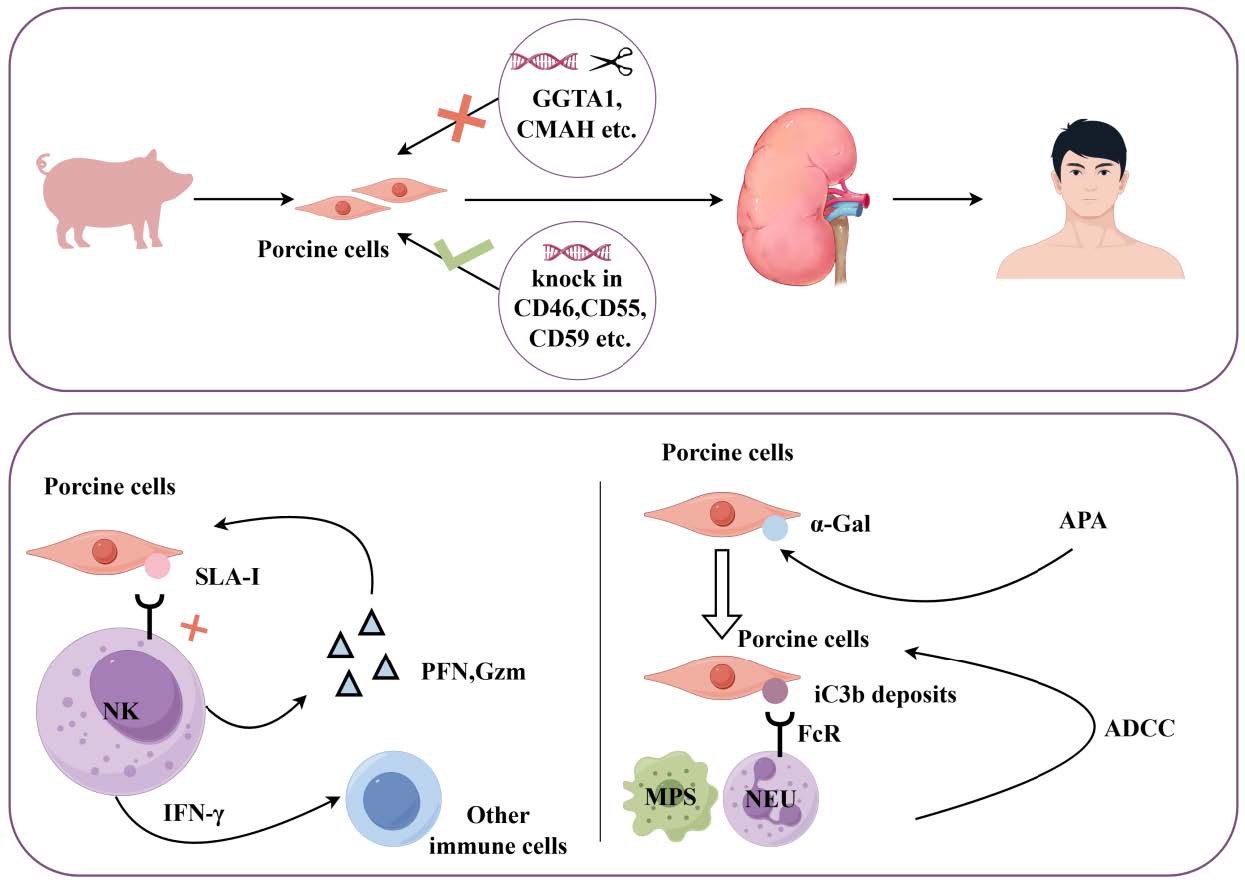
Figure 1. Immune barriers and gene-editing strategies in xenotransplantation. Gene-editing technologies enable the deletion of major porcine xenoantigens (e.g., GGTA1, CMAH) and the introduction of human regulatory genes (e.g., CD46, CD55, CD59) to reduce complementmediated injury and immune rejection. The schematic illustrates the main immune pathways involved in xenograft rejection—including humoral responses (complement activation, natural killer cells) cellular responses (macrophages, neutrophils)—as well as the molecular strategies used to improve graft compatibility. Created with BioRender.com. GGTA1, α-1,3-alactosyltransferase; CMAH, CMP-N-acetylneuraminic acid hydroxylase; CD46, membrane cofactor protein; CD55, decay-accelerating factor; CD59, membrane attack complex inhibitory protein; SLA-I, swine leukocyte antigen class I; NK, natural killer cell; PFN, perforin; Gzm, granzyme; IFN-γ, interferon-gamma; α-Gal, galactose-α-1,3-galactose; APA, alternative pathway of complement activation; iC3b, inactive complement component 3b; FcR, Fc receptor; MPS, mononuclear phagocyte system; NEU, neutrophil; ADCC, antibody-dependent cell-mediated cytotoxicity.
Animal models are essential for bridging experimental research and clinical application in xenotransplantation. Pig-to-nonhuman primate transplantation models are widely used to investigate graft survival, immune responses, and systemic complications associated with xenografts.
Recent studies using genetically modified pigs have demonstrated significant improvements in xenograft survival in preclinical models [6, 8]. These experiments indicate that combining genetic engineering of donor animals with optimized immunosuppressive strategies can substantially reduce early immune injury.
Although these findings are encouraging, additional studies are required to evaluate long-term graft function, immune compatibility, and safety before xenotransplantation can be widely applied in clinical practice.
The major technological advances discussed in this article are summarized in Supplementary Table 1.
The development of xenotransplantation raises several important ethical and biosafety questions. One major concern is the welfare of donor animals. The production of genetically modified pigs involves breeding, genetic manipulation, and controlled housing conditions, all of which must follow strict ethical guidelines to ensure humane treatment.
Another important issue is the potential risk of zoonotic infection. Porcine endogenous retroviruses and other porcine microorganisms may theoretically be transmitted to human recipients. Although gene-editing technologies and pathogen-free breeding programs have significantly reduced these risks, long-term monitoring of recipients remains essential [10].
Furthermore, the future implementation of xenotransplantation will depend on public acceptance and transparent regulatory frameworks. Policies addressing donor animal welfare, recipient monitoring, and equitable access to transplantation technologies will be critical for the responsible development of this field.
Organ transplantation is entering a new era in which advances in organ preservation and the search for alternative donor sources are becoming increasingly interconnected. Machine perfusion technologies have already improved the preservation and evaluation of donor organs, while xenotransplantation offers a potential long-term solution to the global shortage of transplantable organs.
Nevertheless, several scientific and ethical challenges remain. Immune incompatibility, coagulation disturbances, zoonotic infection risks, and regulatory considerations must all be addressed before xenotransplantation can become a routine clinical therapy.
Future progress will require close collaboration across multiple disciplines, including transplantation surgery, immunology, genetic engineering, and bioethics. Through continued technological innovation and responsible governance, xenotransplantation may ultimately provide a sustainable solution for patients suffering from end-stage organ failure.
Author contributions
Lu Cheng conceived the manuscript, wrote the original draft, and approved the final version.
Funding
This work was supported by the Yunnan Fundamental Research Projects (Kunming Medical University) (202401AY070001-164) and the Yunnan Provincial Clinical Medicine Research Special Program (202405AJ310003).
Data availability
Data sharing is not applicable to this article, as no datasets were generated or analyzed during the current study. All information is derived from publicly available articles and datasets.
Ethics approval and consent to participate
Not applicable. This manuscript does not contain any studies involving human participants or animals performed by any of the authors.
Consent for publication
Not applicable. This manuscript does not include any details, images, or videos relating to an individual person.
Competing interests
The author declares no competing interests.
Acknowledgements
Not applicable.
[1] Schroder JN, Patel CB, DeVore AD, Casalinova S, Koomalsingh KJ, Shah AS, et al. Increasing utilization of extended criteria donor hearts for transplantation: The OCS heart EXPAND trial. J Am Coll Cardiol HF. 2024 Mar;12(3):438-447. https://doi.org/10.1016/j.jchf.2023.11.015
[2] Guo Z, Zhao Q, Jia Z, Huang C, Wang D, Ju W, et al. A randomized-controlled trial of ischemia-free liver transplantation for end-stage liver disease. J Hepatol. 2023;79(2):394-402. https://doi.org/10.1016/j.jhep.2023.04.010
[3] Pan W, Zhang W, Zheng B, Camellato BR, Stern J, Lin Z, et al. Cellular dynamics in pig-to-human kidney xenotransplantation. Med. 2024 Aug 9;5(8):1016-1029.e4. https://doi.org/10.1016/j.medj.2024.05.003
[4] Chaban R, Ileka I, McGrath G, Kinoshita K, Habibabady Z, Ma M, et al. Extended survival of 9-and 10-gene-edited pig heart xenografts with ischemia minimization and CD154 costimulation blockade-based immunosuppression. J Heart Lung Transplant. 2024 Dec;43(12):1932-1944. https://doi.org/10.1016/j.healun.2024.07.022
[5] Dajti G, Vaccaro MC, Germinario G, Comai G, Caputo F, Odaldi F, et al. Hypothermic oxygenated perfusion in extended criteria donor kidney transplantation—a randomized clinical trial. Clin Transplant. 2025;39(5):e70166. https://doi.org/10.1111/ctr.70166
[6] Yang C, Wei Y, Li X, Xu K, Huo X, Chen G, et al. Production of four-gene (GTKO/hCD55/hTBM/hCD39)-edited donor pigs and kidney xenotransplantation. Xenotransplantation. 2024;31(4):e12881. https://doi.org/10.1111/xen.12881
[7] Adams AB, Lovasik BP, Faber DA, Burlak C, Breeden C, Estrada JL, et al. Anti-C5 antibody tesidolumab reduces early antibody-mediated rejection and prolongs survival in renal xenotransplantation. Ann Surg. 2021;274(3):473-480. https://doi.org/10.1097/sla.0000000000004996
[8] Kim SC, Mathews DV, Breeden CP, Higginbotham LB, Ladowski J, Martens G, et al. Long-term survival of pig-to-rhesus macaque renal xenografts is dependent on CD4 T cell depletion. Am J Transplant. 2019;19(8):2174-2185. https://doi.org/10.1111/ajt.15329
[9] Wang D, Bai X, Wang B, Yi Q, Yu W, Zhang X, et al. CTLA4Ig/VISTA1g combination therapy selectively induces CD4+ T cell-mediated immune tolerance by targeting the SOCS1 signaling pathway in porcine islet xenotransplantation. Immunology. 2022;166(2):169-184. https://doi.org/10.1111/imm.13463
[10] Gordon EJ, Gusmano MK, Gacki-Smith J, Brooks HL, Matthews MM, Manning D, et al. Patients' information needs for informed consent to participate in first-in-human pig kidney xenotransplant clinical trials: A mixed methods study. Xenotransplantation. 2025;32(1):e70016. https://doi.org/10.1111/xen.70016
ISSN: 2957-5443
Volume 4, Issue 2
June 2026
Pages: 149-277


 Log In

 On This Page
 CITE
CITE