 Log In
Search




 Open Access
 xuwennhet@163.comOpen Accessxuwennhet@163.com
Oxidative stress serves as the central pathological hub of various major diseases such as cancer, neurodegenerative disorders, sepsis, and perioperative organ injury. Its core is an imbalance between reactive oxygen species (ROS) production and the body’s antioxidant defense system, which can bidirectionally regulate DNA damage and immune activation. Therefore, understanding its homeostatic mechanisms is critical for disease prevention and treatment, particularly in organ protection and prognosis improvement for perioperative anesthetized and critically ill patients (Figure 1).

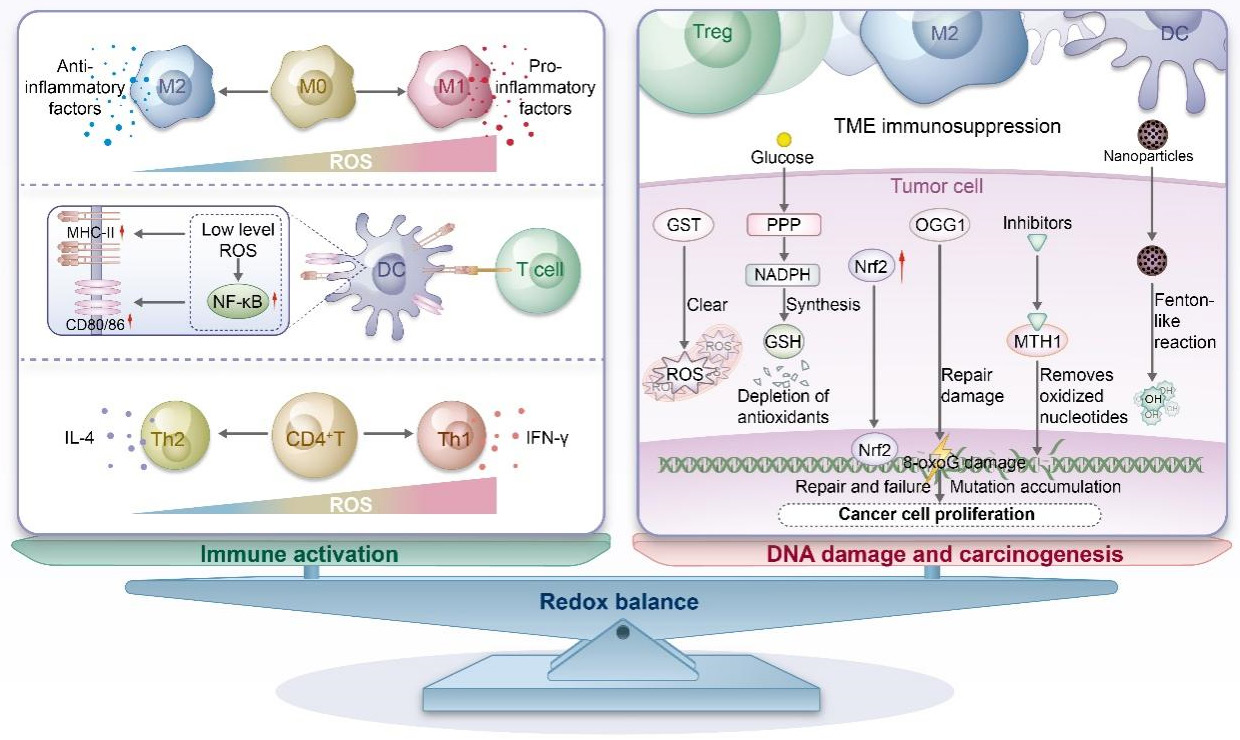
Figure 1. The dual roles of oxidative stress: balance, imbalance, and targeted intervention. ROS serve as critical signaling molecules that regulate immune activation. They promote macrophage polarization, enhance dendritic cell antigen presentation via activation of the NF-κB pathway, and regulate CD4⁺ T cell differentiation to maintain immune surveillance. Excess ROS can directly induce DNA damage in cells. Although OGG1 is involved in repairing such damage, sustained ROS exposure results in uncontrolled DNA lesions and increased genomic instability. Cancer cells maintain relatively high ROS levels to activate proliferative signaling pathways, and they enhance their antioxidant capacity via Nrf2 upregulation and metabolic reprogramming to drive tumor progression. Multiple targeted intervention strategies have been developed for oxidative stress dysregulation. Nanocatalytic materials can disrupt the redox balance of tumor cells and induce DNA damage via localized Fenton-like generation of hydroxyl radicals, GSH depletion, and blockade of DNA repair pathways. ROS, reactive oxygen species; NF-κB, nuclear factor kappa B; CD4⁺ T cell, cluster of differentiation 4-positive T cell; OGG1, 8-oxoguanine DNA glycosylase 1; Nrf2, nuclear factor erythroid 2–related factor 2; GSH, glutathione; M0, M0 macrophage; M1, M1 macrophage; M2, M2 macrophage; DC, dendritic cell; Treg, regulatory T cell; Th1, T helper 1 cell; Th2, T helper 2 cell; IL-4, interleukin-4; IFN-γ, interferon-gamma; MHC-II, major histocompatibility complex class II; CD80/86, cluster of differentiation 80/86; TME, tumor microenvironment; GST, glutathione S-transferase; PPP, pentose phosphate pathway; NADPH, nicotinamide adenine dinucleotide phosphate; MTH1, MutT homolog 1; 8-oxoG, 8-oxoguanine.
The core of oxidative stress is the functional mismatch between ROS generation including superoxide anion, hydrogen peroxide and other species, and the activity of antioxidant systems including superoxide dismutase, glutathione and catalase, rather than an absolute increase in ROS levels. Its biological effects are highly dependent on concentration, duration of action and cellular compensatory capacity [1].
Moderate, controlled oxidative stress can function as a physiological signaling cue to trigger immune responses and facilitate pathogen clearance; conversely, excessive, sustained oxidative stress induces irreversible damage to biological macromolecules including lipids, proteins and DNA [1]. Taking the classic oxidative stress inducer H2O₂ as an example, at low concentrations ranging from nanomolar to low micromolar levels, ROS govern key signaling pathways such as protein kinase B phosphorylation via reversible redox modification; once concentrations exceed the cellular tolerance threshold such as ≥100 μM, ROS shift to a potent cytotoxic agent that triggers cell death and tissue injury [2]. Notably, telomeric DNA at chromosome ends is highly vulnerable to ROS attack. Persistent oxidative stress accelerates telomere shortening and dysfunction, induces cellular senescence and genomic instability, features that are also core mechanisms underlying inflammatory diseases, malignant tumor progression, and accelerated perioperative organ senescence [2]. Clinical scenarios including perioperative ischemia-reperfusion, mechanical ventilation, anesthetic exposure and sepsis are all key triggers of systemic oxidative stress imbalance in the body.
Sustained ROS attack on DNA elicits multiple forms of damage, including base oxidation typified by 8-oxoguanine formation, DNA strand breaks, and protein-DNA cross-linking. The body executes damage repair via multi-tiered mechanisms such as base excision repair, nucleotide excision repair and homologous recombination repair. Among these, key base excision repair pathway enzymes such as 8-oxoguanine DNA glycosylase 1 not only directly repair oxidized bases, but also preserve tissue barrier integrity and immune microenvironment homeostasis by regulating cytokine expression [3].
The primary pathogenic consequence of persistent oxidative stress is not mere cytotoxicity, but the accumulation of oncogenic mutations driven by induced genomic instability, coupled with epigenetic alterations including DNA methylation and histone modification. These changes collectively drive uncontrolled cell proliferation and apoptotic evasion, ultimately promoting tumor initiation and progression [1]. Cancer cells consistently maintain higher ROS levels than normal cells: on one hand, they drive proliferative and survival signaling via activation of pathways such as mitogen-activated protein kinase-extracellular signal-regulated kinase and phosphoinositide 3-kinase-protein kinase B; on the other hand, they counteract the cytotoxicity of elevated ROS by upregulating antioxidant transcription factors such as nuclear factor erythroid 2-related factor 2 (Nrf2) and reprogramming metabolic pathways, thereby sustaining malignant progression [4]. In the fields of anesthesiology and critical care medicine, persistent oxidative stress induced by pathological states including perioperative ischemia-reperfusion, cardiopulmonary bypass, and sepsis disrupts DNA damage-repair homeostasis in vital organ cells such as renal tubular epithelial cells, alveolar epithelial cells, and cardiomyocytes. This disruption represents the core pathological mechanism underlying the development of postoperative multiple organ dysfunction syndrome.
Oxidative stress exhibits a tightly regulated threshold effect in modulating immune responses. Physiological levels of ROS are indispensable for normal immune system activation: during the innate immune phase, ROS promote macrophage polarization toward the pro-inflammatory M1 phenotype, stimulate the release of cytokines such as tumor necrosis factor-alpha and interleukin-1 beta, and enhance Toll-like receptor pathway activity and macrophage bactericidal capacity [5]. During antigen presentation, ROS upregulate dendritic cell expression of major histocompatibility complex class II molecules and co-stimulatory molecules via nuclear factor kappa-B pathway activation, boosting antigen presentation efficiency [6]. During the adaptive immune phase, ROS finely tune T cell activation and differentiation to maintain normal host defense function [7].
However, when oxidative stress remains chronically uncontrolled, physiological immune activation quickly transitions into chronic inflammation and immune dysfunction, acting as a key pathogenic driver of disease progression. This effect is particularly pronounced in the tumor microenvironment: ROS produced by cancer cells and stromal cells induce the infiltration of immunosuppressive cells, establishing a self-reinforcing positive feedback loop between oxidative stress and inflammation that ultimately drives immune escape [8]. In perioperative and critical care settings, this threshold effect directly determines patient prognosis: uncontrolled oxidative stress in patients with sepsis and acute respiratory distress syndrome not only triggers cytokine storms to exacerbate tissue injury, but also induces aberrant macrophage polarization and T cell exhaustion, leading to immune paralysis and significantly increasing the risk of secondary infection and mortality. Meanwhile, anesthetic agents and perioperative management strategies can modulate postoperative immune function and infection risk by regulating systemic oxidative stress levels.
The dual nature of oxidative stress dictates that the core of clinical intervention is precision-targeted homeostasis control—excessive oxidative stress can be corrected via antioxidant strategies to mitigate DNA damage for disease prevention and organ protection, while moderate oxidative stress can be strategically harnessed in specific contexts to activate immunity, or tumor cell redox homeostasis can be selectively disrupted to induce cancer cell death.
Nevertheless, traditional non-selective antioxidant therapies carry marked clinical limitations. Multiple large-scale clinical trials and basic studies have confirmed that universal antioxidant supplements yield no preventive or therapeutic benefits, and instead increase lung cancer risk in smokers and accelerate tumor growth in murine models, fully demonstrating that disruption of redox homeostasis on either end exacerbates pathological progression [9, 10]. In anesthesiology and critical care medicine, regulating redox balance has emerged as a research focus for perioperative organ protection and critical care management. Use of volatile anesthetics and clinically routine agents such as dexmedetomidine can moderately modulate ROS levels and activate the Nrf2 antioxidant pathway, attenuating ischemia-reperfusion induced DNA damage and immune dysfunction to confer perioperative protection for vital organs including the heart, brain and kidneys. For sepsis treatment, research has abandoned non-selective antioxidant therapy, shifting focus to precise intervention strategies that target excess ROS clearance while preserving the physiological immune-activating function of ROS.
In addition, strategies targeting the disruption of tumor cell redox homeostasis have demonstrated notable translational potential. For instance, nanocatalytic platforms can specifically amplify oxidative damage in tumor tissues and block DNA repair pathways to achieve precision anti-tumor therapy. The development of detection technologies for highly sensitive oxidative stress biomarkers such as 8-oxo-7,8-dihydro-2’-deoxyguanosine has also laid critical groundwork for accurate assessment of patient oxidative stress status and implementation of individualized interventions [11].
In summary, oxidative stress modulates two core biological processes, DNA damage and immune activation, simultaneously via concentration-dependent bidirectional effects. Future research and clinical practice should focus on the precise identification and control of redox balance points in specific pathological microenvironments, minimizing pathological DNA damage while preserving or enhancing physiological immune activation, ultimately delivering optimized strategies for the prevention and treatment of tumors, perioperative organ injury, severe sepsis and other related diseases.
Author contributions
Yalin Zhu and Long Peng contributed to the manuscript writing and figure preparation, Yalin Zhu and Wen Xu designed the work, Yimin Zhang, Haiwen Wang, and Wen Xu supervised the study. All authors have read and approved the article.
Funding
This study was funded by the Zhoushan Medical and Health Technology program (2023JYB01).
Data availability
Not applicable.
Ethics approval and consent to participate
Not applicable.
Consent for publication
Not applicable. This manuscript does not include details, images, or videos relating to an individual person.
Competing interests
The authors declare that they have no conflict of interest.
Acknowledgements
Not applicable.
[1] Glorieux C, Liu S, Trachootham D, Huang P. Targeting ROS in cancer: rationale and strategies. Nat Rev Drug Discov. 2024 Aug;23(8):583-606. https://doi.org/10.1038/s41573-024-00979-4
[2] Sun Y, Lu Y, Saredy J, Wang X, Drummer Iv C, Shao Y, et al. ROS systems are a new integrated network for sensing homeostasis and alarming stresses in organelle metabolic processes. Redox Biol. 2020 Oct;37:101696. https://doi.org/10.1016/j.redox.2020.101696
[3] Ma X, Ming H, Liu L, Zhu J, Pan L, Chen Y, et al. OGG1 in lung- more than base excision repair. Antioxidants (Basel). 2022 May 9;11(5):933. https://doi.org/10.3390/antiox11050933
[4] Hayes JD, Dinkova-Kostova AT, Tew KD. Oxidative stress in cancer. Cancer Cell. 2020 Aug 10;38(2):167-197. https://doi.org/10.1016/j.ccell.2020.06.001
[5] Zhang Y, Choksi S, Chen K, Pobezinskaya Y, Limnoila I, Liu ZG. ROS play a critical role in the differentiation of alternatively activated macrophages and the occurrence of tumor-associated macrophages. Cell Res. 2013 Jul;23(7):898-914. https://doi.org/10.1038/cr.2013.75
[6] Rutault K, Alderman C, Chain BM, Katz DR. Reactive oxygen species activate human peripheral blood dendritic cells. Free Radic Biol Med. 1999 Jan;26(1-2):232-238. https://doi.org/10.1016/s0891-5849(98)00194-4
[7] Rockwell CE, Zhang M, Fields PE, Klaassen CD. Th2 skewing by activation of Nrf2 in CD4(+) T cells. J Immunol. 2012 Feb 15;188(4):1630-1637. https://doi.org/10.4049/jimmunol.1101712
[8] Wang M, Xiao Y, Miao J, Zhang X, Liu M, Zhu L, et al. Oxidative stress and inflammation: Drivers of tumorigenesis and therapeutic opportunities. Antioxidants (Basel). 2025 Jun 15;14(6):735. https://doi.org/10.3390/antiox14060735
[9] Omenn GS, Goodman GE, Thornquist MD, Balmes J, Cullen MR, Glass A, et al. Effects of a combination of beta carotene and vitamin A on lung cancer and cardiovascular disease. N Engl J Med. 1996 May 2;334(18):1150-1155. https://doi.org/10.1056/nejm199605023341802
[10] Sayin VI, Ibrahim MX, Larsson E, Nilsson JA, Lindahl P, Bergo MO. Antioxidants accelerate lung cancer progression in mice. Sci Transl Med. 2014 Jan 29;6(221):221ra15. https://doi.org/10.1126/scitranslmed.3007653
[11] Song Q, Zhang Y, Deng X, Zhao H, Zhang Y, Li J, et al. Amplification of oxidative stress with a hyperthermia-enhanced chemodynamic process and MTH1 inhibition for sequential tumor nanocatalytic therapy. J Mater Chem B. 2023 May 3;11(17):3836-3850. https://doi.org/10.1039/d2tb02673b
ISSN: 2957-5443
Volume 4, Issue 2
June 2026
Pages: 149-277


 Log In

 On This Page
 CITE
CITE